





Why Is a Distillate Distilled More Than Once?
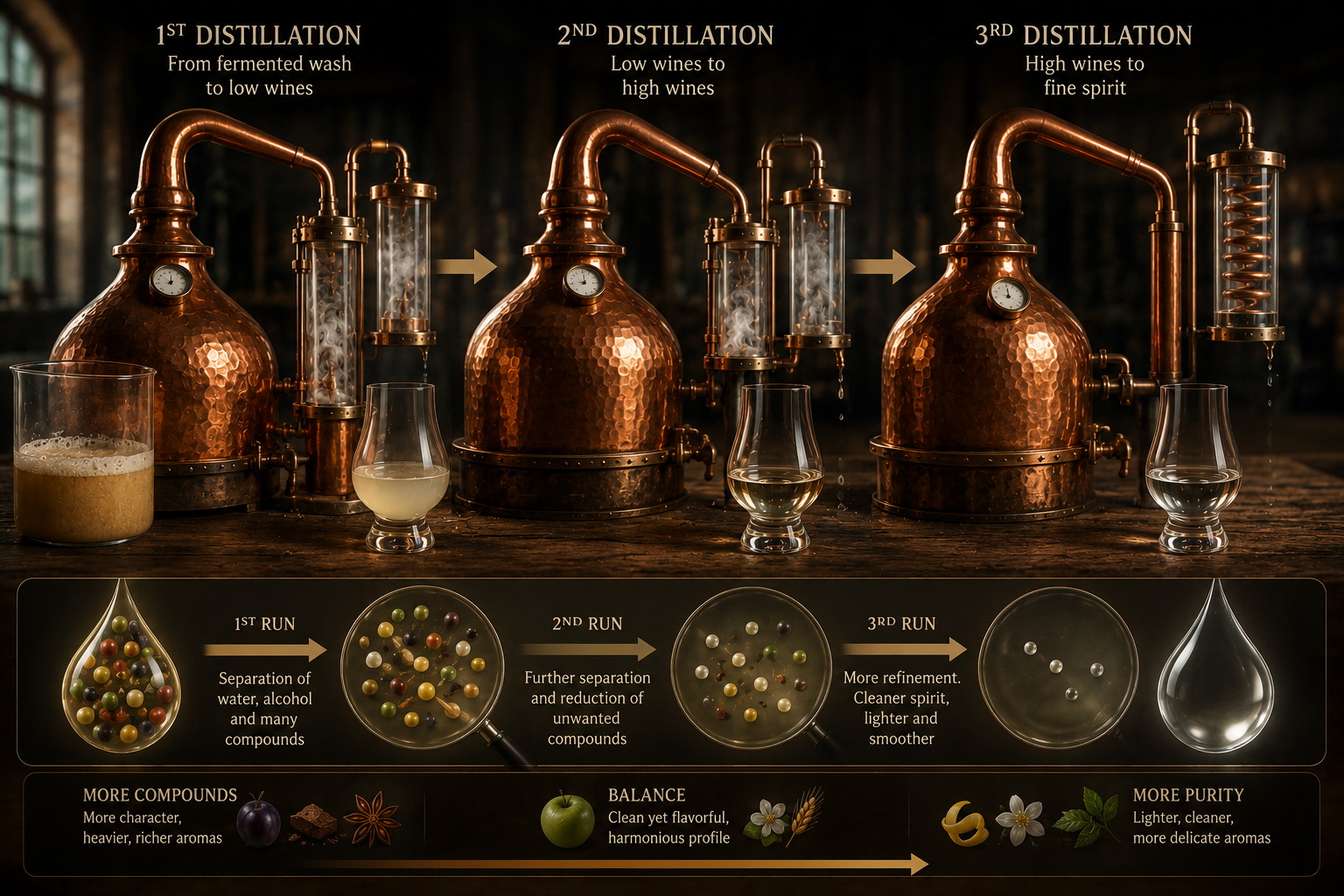
If you look at the production methods behind different spirits, an interesting pattern quickly appears. Some distillates are produced in a single run, others are distilled twice, and some go through three or even more stages of distillation.
That raises an obvious question: if alcohol has already been collected after the first distillation, why distill it again?
The reason is not simply to make the spirit stronger.
Each additional distillation gives the producer another opportunity to reshape the composition of the future spirit by changing the balance between water, ethanol, and the many aromatic compounds created during fermentation.
Repeated distillation can make a spirit cleaner, lighter, and smoother. At the same time, excessive purification can also remove some of the character of the original raw material.
That is why the number of distillation runs is not a simple case of “more is better.” It is one of the tools used to define the style of a spirit.
What Happens During the First Distillation?
The first distillation begins with fermented raw material.
Depending on the type of spirit, this may be a fermented base made from:
- grapes;
- apples;
- plums;
- grain;
- honey;
- other sugar- or starch-based raw materials.
After fermentation, this liquid contains water, ethanol, and many other compounds.
These may include esters, organic acids, aldehydes, higher alcohols, sulfur-containing compounds, and countless other volatile substances.
During the first distillation, part of this complex mixture enters the vapor phase and is then condensed back into liquid.
The result is a new liquid with a higher alcohol concentration and a different balance of aromatic compounds.
Why Might One Distillation Not Be Enough?
The first run already changes the fermented base significantly, but the resulting distillate can still be a very complex mixture.
It may still contain a large number of volatile compounds.
Some of these create desirable raw-material character, while others may contribute:
- excessive harshness;
- heavy aromas;
- undesirable sulfur-like notes;
- an overly oily character;
- other characteristics the producer does not want in the finished spirit.
A second distillation provides another opportunity to separate and rebalance that mixture.
What Changes During the Second Distillation?
During the second distillation, the producer is no longer working with the original fermented liquid, but with the product of the first run.
Its composition is already very different.
Another cycle of evaporation and condensation changes the balance of components again.
This allows the producer to define the central fraction — the “heart” — more precisely and shape the aromatic profile of the future spirit.
The second run is therefore often where the character of the final distillate becomes much more focused.
Does the Spirit Become Stronger After Every Distillation?
Repeated distillation generally increases the concentration of ethanol.
But alcohol strength is only one part of the story.
Just as importantly, the composition of aromatic compounds changes as the spirit is redistilled.
Two distillates with the same ABV can therefore have completely different aromas, flavors, and textures depending on how they were produced.
The number of distillation runs cannot be understood simply by looking at alcohol strength.
What Is Double Distillation?
Double distillation means that the spirit passes through two consecutive distillation runs.
During the first run, alcohol and volatile aromatic compounds are separated from much of the water and non-volatile material in the fermented base.
The intermediate distillate is then distilled again.
The second run allows more precise work with fractions and gives the producer greater control over the final aromatic profile.
This approach is widely used in many traditional styles of characterful spirits.
Why Is Triple Distillation Used?
A third distillation gives the producer another opportunity to refine the composition of the spirit.
In general, it can create a lighter and cleaner alcoholic profile.
Some heavier aromatic compounds are reduced, while ethanol concentration typically increases.
The resulting spirit may feel:
- lighter;
- cleaner;
- smoother;
- less oily;
- more delicate aromatically.
But that does not mean triple distillation automatically produces a better spirit.
What Is the Difference Between Double and Triple Distillation?
In very simple terms, each additional run gives the producer another opportunity to separate and rebalance components.
Double distillation may preserve more weight, texture, and heavier aromatic characteristics.
Triple distillation can move the style toward greater lightness and purity.
But this is only a general tendency.
The final result also depends on still design, natural or controlled reflux, distillation speed, copper contact, and where the producer makes the cuts.
The number of runs therefore cannot be considered separately from the rest of the production process.
Does Triple Distillation Always Produce a Cleaner Spirit Than Double Distillation?
All else being equal, an additional distillation generally gives the producer more opportunity to purify and separate components.
But in real production, “all else being equal” almost never applies.
Separation efficiency depends heavily on the equipment being used.
A modern column can create many repeated evaporation-condensation cycles within a single continuous process.
For that reason, simply counting the number of separate distillation runs does not always reveal the true degree of purification.
Why Does Repeated Evaporation Purify a Distillate?
Different components in a liquid mixture have different volatilities.
When the liquid evaporates, the composition of the vapor is different from the composition of the liquid it came from.
When that vapor condenses, a new mixture is created.
If this new mixture is evaporated and condensed again, its composition changes once more.
Repeated distillation is therefore another stage of separation.
Do Undesirable Compounds Disappear After the Second Distillation?
Distillation should not be imagined as a magical cleaning process in which every undesirable substance simply disappears.
Many volatile compounds travel through the still together with ethanol.
The goal is to change their concentration and manage the fractions correctly.
That is why what matters is not only how many times a spirit is distilled, but how each distillation is carried out.
How Does Redistillation Affect the Heads, Hearts, and Tails?
Each new distillation run once again creates a gradual shift in the composition of the output.
Certain more volatile compounds are stronger early in the run, the desired balance forms in the middle, and heavier compounds become increasingly prominent toward the end.
Redistillation gives the producer another chance to define the boundaries between these zones.
This allows more precise control over the heart of the final spirit.
Why Can a Spirit Become Smoother After Multiple Distillations?
The perception of alcoholic harshness depends on more than ABV.
The composition of accompanying volatile compounds matters greatly.
If repeated distillation reduces the concentration of substances that create aggressive, rough, or heavy aromas, the spirit may feel cleaner and smoother.
Interestingly, its actual alcohol strength may be higher at the same time.
A higher-strength spirit can therefore sometimes feel softer than a lower-strength one.
Does Aroma Become Weaker After Every Distillation?
Often, but not always in the same way for every aromatic compound.
Repeated distillation changes the proportions between them.
Some heavier aromas may decrease, while lighter fruity or floral components may remain noticeable.
The aroma may therefore become not simply weaker, but different.
A rich, oily spirit may evolve into something lighter, cleaner, and more delicate.
Can a Spirit Be Distilled Over and Over Again?
Technically, purification can be repeated many times.
But for an aromatic spirit, that does not necessarily make sense.
The more aggressively a producer purifies the alcohol, the fewer compounds remain to express the origin of the raw material.
At a certain point, the spirit begins to move toward the character of neutral alcohol.
For some products, that is exactly the goal.
For others, it would be undesirable.
Why Is Neutral Spirit Also “Distilled” Many Times?
When the goal is highly neutral alcohol, the producer tries to separate ethanol as thoroughly as possible from accompanying aromatic compounds.
This is usually done with rectification columns.
Inside such a column, many repeated cycles of condensation and re-evaporation occur during a single production process.
In a sense, one column run can achieve the equivalent of many separate distillation stages.
This is why rectified spirit is much more neutral aromatically than a traditional characterful distillate.
Are Distillation and Rectification the Same Thing?
Both are based on evaporation and condensation, but their production goals may be very different.
When making an aromatic distillate, the producer usually wants to preserve some volatile compounds from the raw material.
With deep rectification, the goal may be to produce alcohol that is as pure and neutral as possible.
The real question is therefore not simply how much purification occurs, but what type of spirit the producer is trying to create.
Why Is Whisky Often Distilled Twice?
For many styles of whisky, double distillation has become a traditional way of balancing purity with the character of fermented grain.
The first run produces an intermediate spirit.
The second allows the producer to define the fractions that will become the basis of the future whisky more precisely.
The exact method varies by region, distillery, and desired style.
Why Are Some Whiskies Distilled Three Times?
Triple distillation is used to create a particular style.
The additional run can make the spirit lighter and more delicate.
For this reason, some producers deliberately use triple distillation as part of the identity of their whisky.
But this does not make it objectively superior to whisky distilled twice.
It simply creates a different profile.
How Many Times Is Brandy Distilled?
Brandy production methods also vary.
Some traditional styles use double distillation in copper pot stills.
Others may be produced with column systems or different technical approaches.
Here too, the number of distillation stages reflects the aromatic profile the producer wants to create from grape or fruit material.
Why Distill a Honey Distillate More Than Once?
Fermented honey creates an especially interesting and complex aromatic base.
It may contain floral, fruity, herbal, waxy, and spicy characteristics.
The goal is not to eliminate these aromas completely.
On the contrary, they may become an important part of the identity of the honey distillate.
Repeated distillation allows the producer to remove undesirable components more precisely while preserving selected aromatic nuances that define the intended style.
For honey spirits, the balance between purity and raw-material character is therefore particularly important.
Can You Still Detect Honey After Several Distillations?
Yes, but it is important to understand what that means.
A finished honey distillate does not necessarily smell like a jar of fresh honey.
Fermentation and distillation transform the aromatic profile dramatically.
Instead of obvious sweetness, the spirit may reveal:
- floral notes;
- meadow herbs;
- ripe fruit;
- light waxy nuances;
- spicy tones;
- subtle honey-floral associations.
A carefully designed process can preserve that connection to the raw material even after multiple distillation stages.
What Matters More: The Number of Distillations or the Equipment?
They cannot really be judged separately.
Two distillations on one type of still may produce a completely different result from two runs on another.
The aromatic profile is also influenced by:
- the shape of the still;
- its height;
- the surface area of copper contact;
- the degree of natural or controlled reflux;
- the speed of the run;
- the way fractions are selected.
So the statement “this spirit is distilled three times” tells only part of the production story.
Does More Distillation Mean Higher Quality?
No.
This is one of the most common myths surrounding strong spirits.
The number of distillation runs is a production parameter, not a quality rating.
A spirit distilled twice may be more complex, richer, and more expressive than one distilled three times.
Likewise, triple distillation may be exactly the right choice for a lighter and more delicate style.
The important question is not “How many times?” but “Why was it distilled that many times?”
Can You Taste How Many Times a Spirit Was Distilled?
Sometimes certain stylistic characteristics may offer clues.
A lighter, cleaner profile may suggest more intensive separation, while a heavier, oilier style may suggest less.
But too many other factors influence the final taste.
Raw materials, fermentation, still design, fraction selection, maturation, and even the type of barrel can have an equally strong or stronger impact.
It is therefore nearly impossible to determine the exact number of distillation runs reliably from tasting alone.
What Happens After the Final Distillation?
Obtaining the distillate is not always the end of production.
After distillation, the spirit may be allowed to rest, diluted to the desired strength, transferred into oak for maturation, or used in blending.
Its aromatic profile continues to evolve during these later stages.
Barrel aging can create especially significant changes.
Distillation therefore establishes the foundation of the spirit’s character, but not necessarily its final form.
One, Two, or Three Distillations: Which Is Best?
There is no universal answer.
One approach may be ideal for a rich fruit distillate, another for a light whisky, and another for honey spirits or a base for gin.
Every additional distillation gives the producer more control over the composition of the spirit.
At the same time, it can move the final product further away from the aromatic identity of the original raw material.
The balance between these two effects defines the style.
Repeated Distillation: In Short
- The first run separates volatile components from the fermented base and concentrates alcohol.
- The second run allows more precise control over the composition and fractions.
- A third run can make the profile lighter and cleaner.
- Every additional distillation changes aroma as well as alcohol strength.
- Excessive purification can reduce the character of the original raw material.
- The number of distillations alone is not a measure of quality.
- Equipment, copper contact, reflux, and fraction selection also strongly affect the result.
- The ideal number of distillation runs depends on the style the producer wants to create.
Conclusion
A distillate is distilled more than once not simply to increase its alcohol strength.
Each additional run gives the producer another chance to reshape the composition of the future spirit.
Undesirable compounds can be reduced, the heart can be defined more precisely, the aroma can become cleaner, and the texture can change.
But purification always comes with a trade-off: together with unwanted substances, some of the aromatic compounds that express the origin of the spirit can also be lost.
That is why double distillation is not inferior to triple distillation, and triple distillation is not automatically better simply because it adds another cycle.
They are different tools for creating different styles.
The art of distillation is not to distill a spirit as many times as possible, but to stop at the point where purity has not yet erased character.