





MeadGIN Basil Smash — A Signature Cocktail with Basil and Lemon
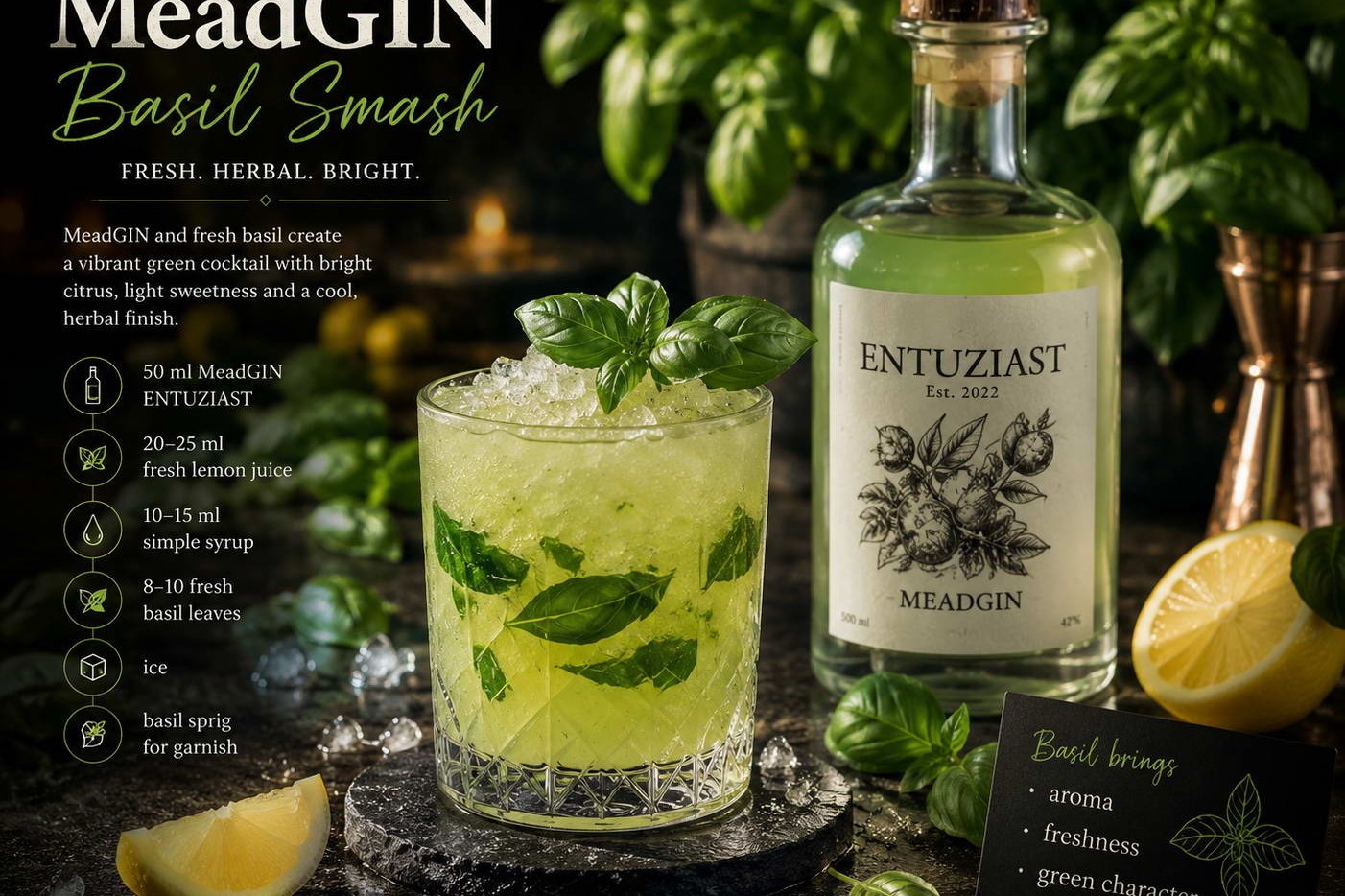
Some cocktails use herbs simply as a garnish. In a Basil Smash, however, fresh basil becomes one of the main characters of the drink.
Its aroma is impossible to miss: green, fresh, herbal, slightly peppery, and unmistakably vibrant.
That is exactly why we wanted to explore this combination with ENTUZIAST MeadGIN.
In the MeadGIN Basil Smash, the botanical character of the gin meets fresh basil, lemon brings bright acidity, and a small amount of syrup helps bring all the components together.
The result is a fresh, aromatic, expressive green cocktail that feels completely different from a classic Gin & Tonic.
What Is a Basil Smash?
The Basil Smash belongs to the world of modern cocktail classics.
Its structure is remarkably simple: gin, fresh basil, lemon juice, and a small amount of simple syrup.
But that simplicity makes balance especially important.
Use too much lemon and the cocktail becomes aggressively sour. Add too much syrup and it loses its freshness. Treat the basil too aggressively and the beautiful herbal aroma can turn into coarse vegetal bitterness.
A good Basil Smash is therefore all about balance.
Why Does MeadGIN Work So Well with Basil?
Gin itself is already built around botanicals.
Juniper, herbs, spices, roots, citrus, and other plant ingredients shape its aromatic character.
Fresh basil continues that botanical theme.
Rather than simply introducing another flavor, it creates an additional aromatic layer over the botanical foundation of MeadGIN.
Lemon makes the composition brighter, while a small amount of sweetness softens the acidity.
This is why MeadGIN Basil Smash remains a cocktail centered on MeadGIN, despite the distinctive presence of fresh basil.
MeadGIN Basil Smash Recipe
- 50 ml ENTUZIAST MeadGIN;
- 20–25 ml fresh lemon juice;
- 10–15 ml simple syrup;
- 8–12 fresh green basil leaves;
- ice;
- a small basil sprig or a few fresh leaves for garnish.
How to Make a MeadGIN Basil Smash
- Place the fresh basil leaves in a cocktail shaker.
- Add the lemon juice and simple syrup.
- Gently press the basil with a muddler to help release its aroma.
- Add 50 ml of ENTUZIAST MeadGIN.
- Fill the shaker with ice.
- Shake vigorously for approximately 10–15 seconds.
- Double strain into a rocks glass over a large piece of ice or into a chilled coupe.
- Garnish with fresh basil.
Why Shouldn't You Crush the Basil into a Pulp?
This is one of the most important details of the recipe.
It may seem logical that the harder you muddle the leaves, the more basil aroma you will extract.
However, along with the aromatic oils, aggressive muddling can release coarse vegetal and bitter notes into the drink.
There is no need to completely crush the basil.
A gentle press is enough to break the surface of the leaves and help their essential oils move into the liquid.
The vigorous shaking that follows will do the rest.
What Kind of Basil Should You Use?
For the basic version, fresh green basil is the best choice.
It has a bright but familiar aromatic profile that works particularly well with citrus and the botanical notes of gin.
The leaves should be fresh, firm, and highly aromatic.
Wilted basil produces considerably less aroma and may introduce less pleasant grassy notes.
Can You Use Purple Basil?
Yes, but it will create a different cocktail.
Purple basil often has a more intense, spicy character. It will also affect the color of the finished drink.
This can be interesting for an experimental variation, but for a classic MeadGIN Basil Smash we recommend fresh green basil.
Why Use Fresh Lemon Juice?
Lemon performs several important functions in this cocktail.
First, it provides the acidity needed to balance the simple syrup.
Just as importantly, citrus works naturally with both fresh basil and the botanical character of MeadGIN.
The acidity makes the herbal aromas feel brighter and prevents the cocktail from becoming heavy.
For this reason, freshly squeezed lemon juice is always the best choice.
Why Add Simple Syrup?
The purpose of simple syrup is not to make the cocktail sweet.
Its job is to balance the acidity of the lemon.
In a properly balanced MeadGIN Basil Smash, sweetness should not appear as a separate, obvious flavor.
If sugar is the first thing you notice, there is probably too much syrup in the drink.
What Color Should a MeadGIN Basil Smash Be?
Basil naturally gives the cocktail a greenish hue.
The intensity of the color depends on the amount of basil, the freshness of the leaves, and the preparation technique.
There is no reason to chase an unnaturally bright green color by aggressively crushing the basil.
For us, aroma and flavor are more important than maximum color intensity.
Why Double Strain the Cocktail?
After shaking, the drink contains many small pieces of basil and tiny fragments of ice.
A standard cocktail strainer catches the larger pieces, while a fine mesh strainer removes the smaller particles.
The result is a cleaner cocktail with a smoother, more pleasant texture.
What Glass Should You Use?
There are two excellent options.
The first is a rocks glass with one large piece of ice. This presentation feels more relaxed and keeps the cocktail cold for longer.
The second is a chilled coupe without ice.
This presentation is more elegant and gives the drink the character of a classic short cocktail.
What Should a MeadGIN Basil Smash Taste Like?
The first impression should be the fresh aroma of basil.
Next comes bright lemon acidity followed by the botanical character of MeadGIN.
The syrup simply rounds out the composition.
The finish should remain fresh, herbal, citrusy, and slightly spicy.
The cocktail should be neither excessively sour nor noticeably sweet.
How Can You Adjust the Balance?
Different lemons vary in acidity, and fresh basil can differ dramatically in aromatic intensity.
For that reason, the recipe should be treated as a reliable starting point rather than an unchangeable formula.
If the cocktail is too sour, add another 2–3 ml of simple syrup.
If it feels too sweet, slightly reduce the syrup or add a few more milliliters of lemon juice.
If the basil begins to overpower the MeadGIN, use fewer leaves next time.
Can You Add Soda Water?
Yes, and this is an interesting way to create a lighter version of the cocktail.
After shaking, strain the MeadGIN Basil Smash into a tall glass filled with ice and add 50–80 ml of soda water.
The result will be a longer, lighter, and even more refreshing drink.
However, at that point it begins to move away from the classic Smash structure.
What Food Goes Well with MeadGIN Basil Smash?
Its fresh herbal character works particularly well with lighter dishes.
The cocktail can be paired with soft cheeses, seafood, fish, vegetable appetizers, salads, and dishes featuring fresh herbs.
It can be especially interesting alongside food that already contains basil, lemon, tomatoes, or subtle spicy notes.
When Should You Serve MeadGIN Basil Smash?
This is an excellent cocktail for warm weather, although it does not need to be limited to a particular season.
Its freshness and acidity make it a natural aperitif.
At the same time, the generous measure of MeadGIN gives it enough structure to work as a complete short cocktail rather than simply a light summer drink.
How Is MeadGIN Basil Smash Different from MeadGIN Tonic?
MeadGIN Tonic is deliberately simple and allows the gin to remain almost unchanged.
MeadGIN Basil Smash takes a much more active approach to aroma.
Basil, lemon, and syrup create a new composition around MeadGIN, while the botanical nature of the gin allows it to integrate naturally into that composition.
These two cocktails therefore reveal completely different sides of the same spirit.
Conclusion
MeadGIN Basil Smash is a good example of how one fresh ingredient can completely transform the character of a cocktail.
Basil contributes green herbal aromas and spice, lemon provides brightness, and a small amount of syrup creates balance.
But at the center of the composition remains ENTUZIAST MeadGIN.
Basil does not hide the botanical character of MeadGIN — it extends it.