





The History of Honey Alcoholic Drinks: From Ancient Civilizations to Modern Distilleries
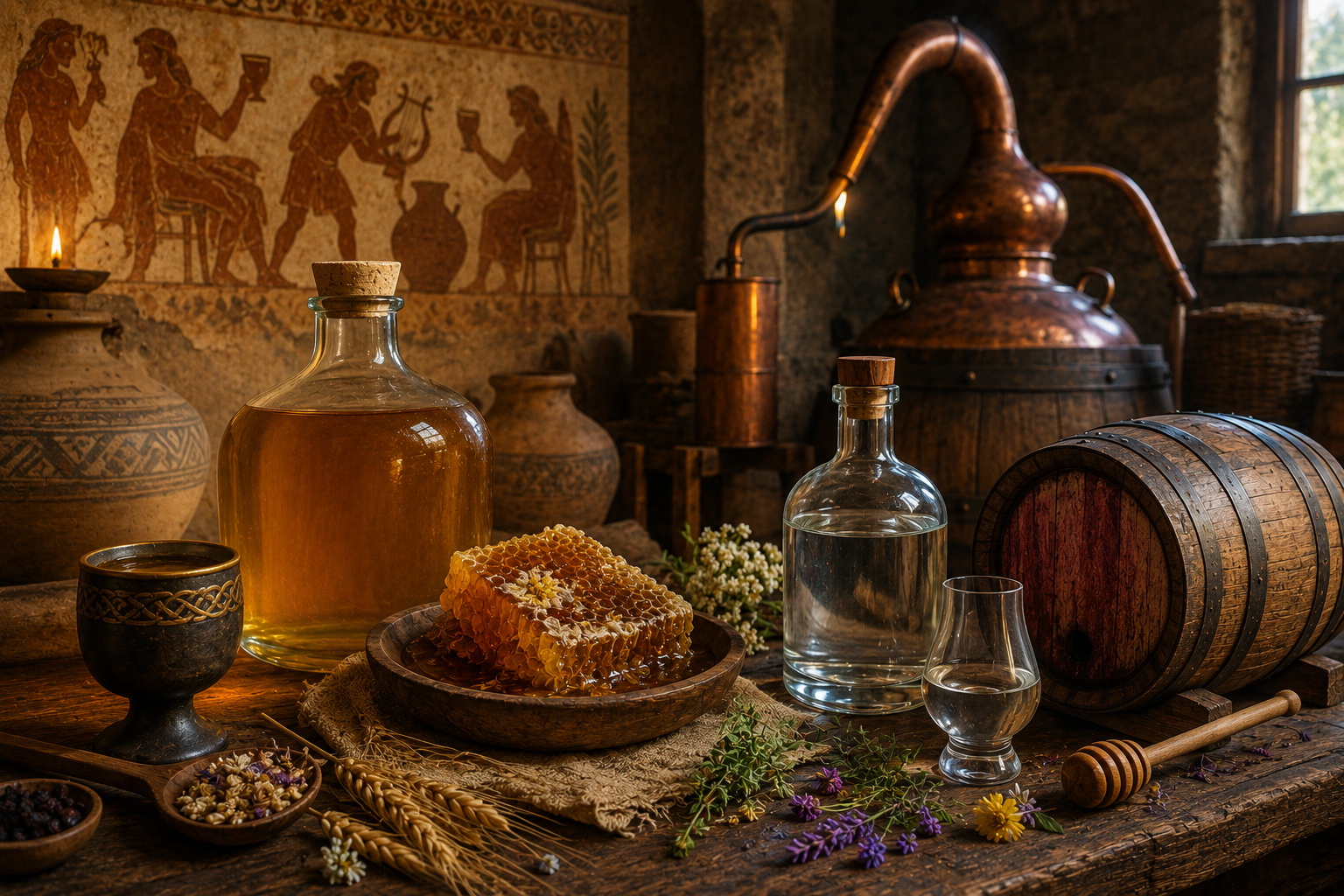
Honey has been part of human life far longer than vineyards, stills, or oak barrels.
Long before modern beekeeping existed, people collected honey from wild bees and valued it as an exceptionally concentrated natural source of sweetness.
And wherever there is honey, water, naturally occurring yeast, and enough time, something else can happen — fermentation.
That is why the history of alcoholic drinks made with honey reaches remarkably far into the past.
But this history cannot be reduced to a simple idea that “people once drank mead and today we make honey spirits.”
The real story is one of constant transformation: from mixed fermented beverages made by ancient agricultural communities to medieval honey drinks, regional traditions, recipes that nearly disappeared, and the modern craft rediscovery of honey as a serious raw material for distillation.
Perhaps the most fascinating part of this story is that the same natural ingredient — honey — has produced completely different drinks in different periods of history.
Can Honey Ferment on Its Own?
Pure honey contains a very high concentration of sugars and relatively little available water.
Because of this, it can remain stable for an exceptionally long time and is not an ideal environment for the active growth of most microorganisms.
But everything changes when honey is diluted with water.
The sugars become more accessible to yeast, and under suitable conditions fermentation can begin.
This simple natural principle lies behind a vast range of historical honey-based alcoholic drinks.
Could Humans Have Discovered Honey Fermentation by Accident?
Quite possibly.
No knowledge of biochemistry is required for it to happen.
A mixture of honey and water simply needs to remain in conditions where naturally occurring yeast can reach it.
After some time, the sweet liquid begins to change: bubbles appear, new aromas develop, acidity changes, and some of the sugar is converted into ethyl alcohol.
To ancient people, the transformation may have seemed almost magical.
But once discovered by accident, the process could gradually be observed, repeated, and eventually controlled.
What Is the Oldest Known Alcoholic Drink Containing Honey?
One of the most fascinating archaeological discoveries comes from the Neolithic settlement of Jiahu in what is now China.
Chemical analysis of residues found in ancient pottery indicates that around the seventh millennium BCE, people there produced a fermented beverage containing rice, honey, and fruit from hawthorn and/or wild grapes.
This is an extraordinary discovery.
However, describing this drink simply as “the world's oldest mead” would not be accurate.
It was more likely a complex mixed fermented beverage in which honey was one of several sources of sugar and aroma.
What the discovery does demonstrate is that humans were using honey as part of alcoholic fermentation thousands of years ago.
Why Were Early Alcoholic Drinks Often Mixed?
Modern consumers are accustomed to clearly defined categories.
Wine comes from grapes. Beer comes from grain. Mead comes primarily from honey.
For many ancient cultures, such distinctions may have mattered far less.
If honey, grain, fruit, berries, and aromatic plants were available at the same time, they could be combined.
The goal was not to comply with classifications that would only appear thousands of years later.
The goal was to create a fermented beverage that tasted good, could be reproduced, and could be stored and consumed.
Why Was Honey Such a Valuable Ingredient?
Before inexpensive refined sugar became widely available, honey was one of the most important concentrated natural sweeteners.
Obtaining it was not easy.
People had to locate bees, reach their combs, and collect a product that the bees themselves had already concentrated to a remarkably high sugar content.
Honey therefore had nutritional, economic, and symbolic value.
Using large quantities of it to produce an alcoholic drink meant dedicating a valuable resource to fermentation.
What Is Mead?
In its broadest modern sense, mead is a fermented beverage made from honey and water, in which yeast converts part of the available sugars into alcohol.
But historical honey drinks were extraordinarily diverse.
The basic mixture could also include:
- berries;
- fruit;
- herbs;
- flowers;
- spices;
- grain;
- other aromatic ingredients.
For this reason, it is misleading to imagine that there was one universal historical recipe for mead.
There was instead an entire family of beverages based on honey fermentation.
Were Honey Drinks Known in the Ancient World?
Fermented beverages containing honey were known in different cultures of the Old World, although their importance relative to wine, beer, and other alcoholic drinks varied by region and period.
Honey was also widely used to sweeten and flavor other beverages.
The historical boundary between a purely honey-based drink, wine sweetened with honey, and various mixed fermented beverages was therefore not always as clear as modern categories might suggest.
Why Are Honey Drinks So Strongly Associated with Northern Europe?
In popular culture, mead is especially associated with Scandinavia and the Viking Age.
There is historical substance behind this association, although films, games, and novels sometimes exaggerate the role of mead in everyday Viking life.
Ale was generally a more accessible everyday beverage, while honey was a valuable ingredient.
Honey-based drinks could have a more special status and appear at feasts, ceremonies, and important social occasions.
What Were Mead Halls?
In Anglo-Saxon and northern European cultural tradition, the great communal feasting hall is often associated with the idea of the mead hall.
Such halls were much more than ordinary living spaces.
They played an important social and political role.
A ruler or local leader could receive guests there, hold feasts, distribute gifts, and reinforce relationships within the community.
In such a setting, mead was more than simply an alcoholic beverage.
It could become part of the ritual of hospitality.
Why Did Honey Appear in Mythology?
Valuable foods and drinks often acquire symbolic meaning.
Across different traditions, honey has been associated with abundance, nature, fertility, and exceptional qualities.
Norse mythology contains the famous story of the Mead of Poetry, a magical drink associated with wisdom and poetic inspiration.
It is a good example of how an actual food product can move from everyday life into the world of mythology.
Was Mead Only a Viking Drink?
No.
That is one of the most common misconceptions surrounding mead.
Fermented honey drinks existed in different parts of Europe and beyond.
Scandinavian stories, medieval literature, and modern popular culture simply made the connection between Vikings and mead particularly recognizable.
The history of honey alcohol is much broader than any single culture.
Why Were Honey Drinks Popular During the Middle Ages?
Where beekeeping was established and honey was available, fermentation offered a way to transform it into a beverage with very different properties from diluted honey itself.
Regional traditions could vary considerably.
Some drinks remained sweet.
Others were fermented much further.
Berries, herbs, and spices could be added.
Alcohol content and flavor depended on the quantity of honey, the microorganisms involved, temperature, fermentation time, and many other factors that were understood primarily through practical experience.
Why Were Herbs and Spices Added to Honey Drinks?
There were several possible reasons.
The most obvious were flavor and aroma.
Plants allowed producers to create very different profiles from the same basic honey mixture.
Historically, however, the boundary between food, drink, and medicine was also much less clearly defined than it is today.
Many herbs were used in traditional medicine, so alcoholic preparations containing honey and plants could acquire additional cultural significance.
Why Did Honey Drinks Become Less Common?
The reasons varied from one region to another.
Viticulture and the wine trade expanded.
Brewing techniques improved.
Grain production increased.
As international trade developed, other sources of sugar gradually became more accessible.
Honey remained a valuable product, and using large quantities of it for fermentation was not always economically attractive.
As a result, honey-based beverages gradually lost ground to other alcoholic traditions in many regions.
Did Mead and Other Honey Drinks Disappear Completely?
No.
The tradition never disappeared entirely.
In some regions, recipes survived through home production, local customs, and small-scale artisanal practices.
Honey-based alcoholic drinks also exist in many regional forms, not all of which fit neatly into one modern category.
It is more accurate to say that, for a time, they ceased to occupy a central place in the drinking culture of many countries.
When Did Distillation Become Part of the Honey Story?
This is where an entirely different chapter begins.
A fermented honey drink and a honey distillate are not the same thing.
To produce a distillate, fermentation must come first.
Yeast converts available honey sugars into alcohol while also producing a large number of aromatic compounds.
Only after this stage is the fermented base distilled.
Distillation concentrates alcohol and allows the distiller to work selectively with volatile aromatic compounds.
This transforms the ancient idea of fermenting honey into a fundamentally different category of drink.
Is Honey Spirit Simply Strong Mead?
No.
They are fundamentally different products.
A fermented honey beverage remains a product of fermentation.
It may contain residual sugars, organic acids, and other non-volatile components.
A honey distillate undergoes an additional technological stage — distillation.
During distillation, volatile substances evaporate and are condensed, while most sugars remain behind in the still.
For this reason, a honey spirit can be completely dry.
Why Isn't a Distilled Honey Spirit Sweet?
This is one of the things that most surprises people when they taste a honey distillate for the first time.
We naturally associate honey with sweetness.
But honey tastes sweet primarily because of its sugars.
During fermentation, a substantial proportion of those sugars is converted into alcohol.
During distillation, the sugars themselves do not meaningfully evaporate and travel with the alcohol vapors into the finished distillate.
The sweetness can therefore disappear while part of honey's aromatic story remains.
So What Remains of the Honey?
Not honey in the literal sense of a spoonful dissolved in the finished drink.
What remains is a much subtler connection with the original raw material.
After fermentation and distillation, the aromatic profile may contain associations with:
- flowers;
- meadow herbs;
- beeswax;
- ripe fruit;
- spices;
- dried plants;
- delicate floral and honey-like nuances.
Honey does not simply disappear.
It is transformed.
Why Can the Variety of Honey Matter?
Honey is never completely uniform.
Its aroma depends on the plants from which bees collected nectar, as well as geography, season, climate, and many other factors.
Acacia honey can have one aromatic direction, linden honey another, and buckwheat honey something entirely different.
Fermentation significantly transforms the original profile, and distillation changes it again.
Yet the original raw material still provides the starting palette with which the distiller works.
Can We Talk About the “Terroir” of Honey?
In a broad sense, the idea is certainly useful.
The aroma of honey is directly connected to the vegetation and environment in which the bees forage.
Meadows, acacia groves, linden trees, and mixed wildflower landscapes provide different sources of nectar.
Honey can therefore act as a kind of aromatic reflection of a landscape.
For a craft producer, this creates an interesting opportunity: to work not simply with a source of fermentable sugar, but with a raw material that has its own botanical and geographical character.
Why Is Honey Challenging to Ferment?
At first glance, the process seems simple: honey contains plenty of sugar, so yeast should have everything it needs.
In reality, sugar concentration is only one factor in healthy fermentation.
Yeast also requires suitable nutrients, appropriate temperature conditions, and a controlled environment.
Working with a honey base therefore requires technological understanding.
The quality of a future distillate begins long before the still is heated — during raw-material preparation and fermentation.
Why Is Honey Distillate Interesting for Craft Producers?
Because it begins with a highly distinctive natural raw material.
Neutral alcohol is deliberately refined to remove as much of the character of its origin as possible.
With an aromatic distillate, the objective can be almost the opposite.
The producer needs to remove undesirable components while avoiding the loss of the spirit's individual character.
In this sense, honey gives the distiller an exceptionally interesting foundation to work with.
Why Age Honey Spirit in Oak?
Not every honey distillate necessarily needs barrel aging.
A clear, unaged spirit may reveal the floral, herbal, and fruity qualities of its raw material more directly.
Oak, however, opens another possibility.
During maturation, vanilla, woody, caramel, spicy, nutty, and other notes can join the spirit's original profile.
The main challenge is to prevent the oak from completely overwhelming the more delicate character of the honey base.
What Can Ex-Wine Casks Add?
The use of barrels that previously held wine makes the process even more interesting.
Several different stories can then meet within a single spirit:
- the botanical origin of the honey;
- fermentation;
- distillation;
- oak;
- the previous wine character of the barrel;
- time.
This is why modern honey distillation can be far more complex than simply “making alcohol from honey.”
How Is Modern Honey Spirit Different from an Ancient Honey Drink?
In almost every way except for the fundamental idea of using honey as a raw material.
An ancient fermented beverage could rely on wild microorganisms, have an unpredictable composition, and combine honey with grain, fruit, and plants.
A modern distillery can control:
- the origin of the honey;
- the composition of the raw materials;
- the yeast;
- fermentation temperature;
- fermentation time;
- distillation;
- fraction selection;
- alcohol strength;
- maturation;
- blending.
Thousands of years of technological development separate an ancient vessel of fermented honey from a modern honey distillate.
Why Is Interest in Honey Alcohol Returning Today?
Modern craft culture has renewed interest in raw materials and their origins.
Consumers increasingly want to know more than the alcohol strength of a drink or the number of years it spent in a barrel.
Other questions are becoming increasingly important:
What is it made from?
Where did the raw material come from?
Who produced it?
What techniques were used?
How does one batch differ from another?
Honey fits naturally into this approach because its aroma is directly connected with plants, bees, season, and place.
Mead and Honey Spirit: Two Branches of the Same Story
There is no need to treat them as competitors.
Mead demonstrates what happens when honey becomes the foundation of a fermented beverage.
Honey spirit takes the process one step further by using a fermented honey base for distillation.
One drink may retain part of the original honey sweetness.
The other may be completely dry.
In one, fermentation remains the defining process.
In the other, fermentation and the work of the distiller come together.
But honey remains at the center of both.
From Wild Honey to the Modern Distillery
Viewed as a single story, the journey is remarkable.
At first, humans found wild bee colonies and collected their honey.
Then someone discovered that honey diluted with water could change and ferment.
Recipes appeared.
Fruit, berries, grain, and herbs were added.
Fermentation gradually became more controlled.
Centuries later, people mastered distillation.
Then came more precise fraction separation, copper stills, repeated distillation, oak maturation, and sophisticated blending.
And honey — one of humanity's oldest natural sources of sweetness — gained an entirely new way of expressing its character.
The History of Honey Alcoholic Drinks: In Short
- Honey was an important natural source of sugar long before modern refined sugar production.
- When diluted with water, honey can become a suitable base for alcoholic fermentation.
- Archaeological research at Jiahu in China revealed a very early mixed fermented beverage made with rice, honey, and fruit.
- Historical honey drinks often included fruit, berries, grain, herbs, and spices in addition to honey.
- Fermented honey beverages existed in many cultures and were not exclusive to Scandinavia.
- Honey acquired particular social and mythological significance in northern European traditions.
- As winemaking, brewing, agriculture, and trade developed, honey drinks became less dominant in many regions.
- The tradition nevertheless never disappeared completely.
- Distillation made it possible to create a fundamentally different product — honey spirit.
- In a honey distillate, honey's sweetness may disappear while part of its aromatic character is transformed and retained.
- Modern craft distilleries combine an ancient raw material with precise control over fermentation, distillation, maturation, and blending.
Conclusion
The history of honey alcohol began long before anything resembling a modern alcohol industry existed.
People did not yet know what yeast or ethyl alcohol were, but they could observe that honey, water, and time were capable of creating something entirely new.
Over thousands of years, this simple idea evolved alongside human civilization.
Honey was combined with fruit and grain.
It became the foundation of fermented beverages.
It found a place in feasts, rituals, mythology, and regional traditions.
Then humanity learned to distill.
Honey gained a new life — not merely as a source of sweetness, but as a raw material whose aromatic character could be transformed through fermentation, distillation, and maturation.
A modern honey distillate is very different from the mixed fermented beverages that people may have consumed thousands of years ago.
Between them lies an enormous distance in time, knowledge, and technology.
And yet they share one remarkably simple starting point.
It all begins with honey.