





Honey Spirit Manhattan — A Classic Manhattan with Entuziast Character
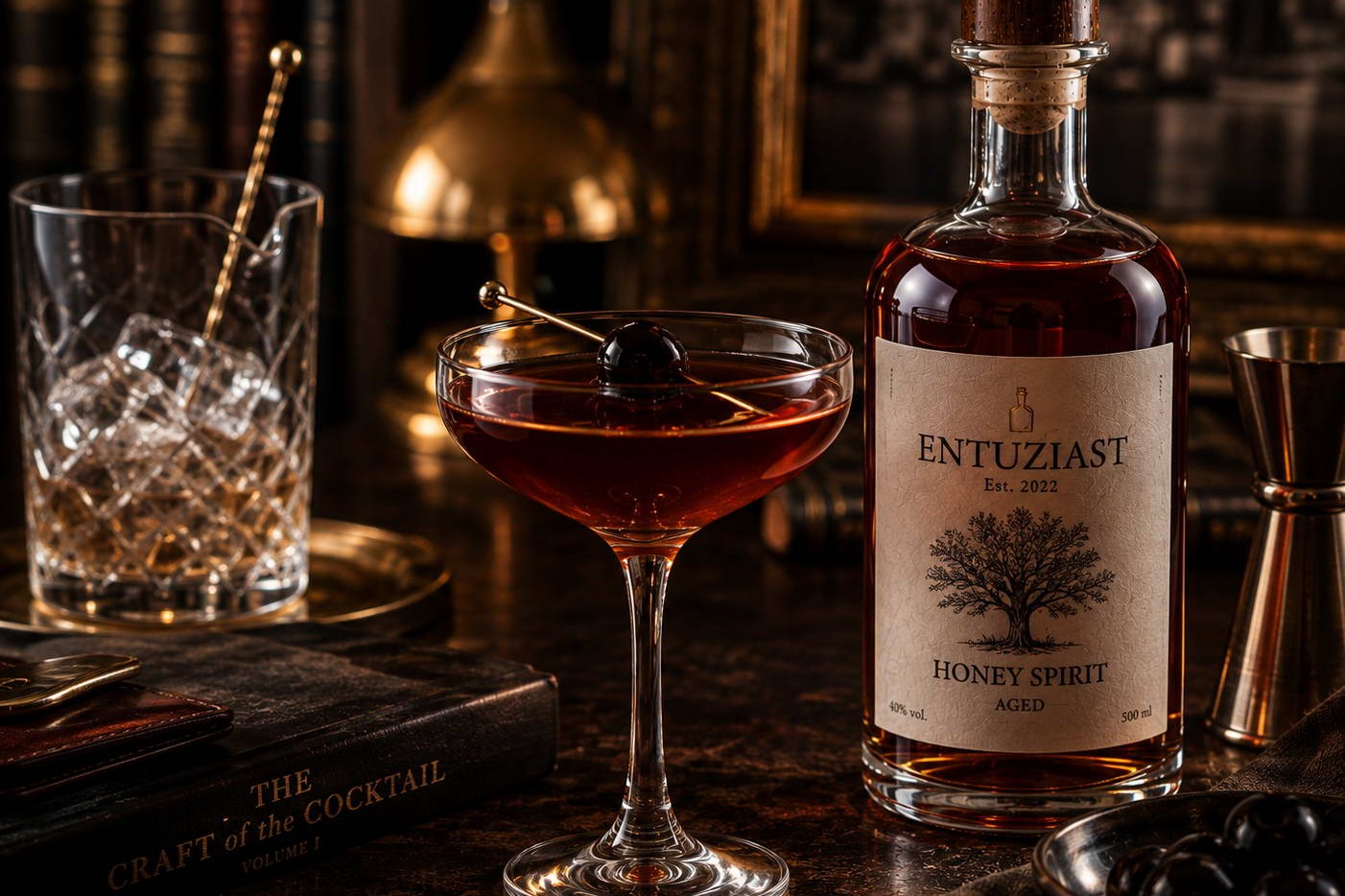
Manhattan is a cocktail that needs neither elaborate decoration, large amounts of ice, nor a long list of ingredients.
In its classic form, everything rests on just three components: an aged spirit, sweet vermouth, and a few dashes of bitters.
That simplicity makes Manhattan particularly demanding when it comes to the base spirit.
There is nowhere for it to hide behind juice, syrup, or soda water. On the contrary, the cocktail puts its character firmly in the spotlight.
This became the starting point for Honey Spirit Manhattan — an Entuziast signature interpretation in which traditional whiskey is replaced by aged Entuziast Honey Spirit.
What Is a Manhattan?
Manhattan is one of the oldest and most recognizable classic cocktails.
Its basic structure has remained remarkably consistent over the decades: an aged spirit combined with sweet vermouth and aromatic bitters.
The traditional base is usually American whiskey — rye or bourbon.
But the logic behind Manhattan is far more interesting than its connection to one particular category of spirit.
At its heart, this cocktail is about the interaction between an aged spirit, wine, herbs, spices, sweetness, and bitterness.
That is exactly why we wanted to discover what would happen when an aged honey distillate took the leading role.
Why Does Honey Spirit Work in a Manhattan?
Ageing changes the character of a distillate.
Contact with wood adds color, roundness, spice, woody nuances, and subtle vanilla notes, while the original character of the spirit becomes more complex.
These are precisely the qualities that work well in the strong alcoholic base of a Manhattan.
The vermouth should not hide the distillate. Instead, it should complement it with vinous, herbal, and spicy notes.
Bitters add another aromatic layer and help bring the entire composition together.
As a result, Honey Spirit does not attempt to imitate whiskey.
It creates its own interpretation of a familiar cocktail structure.
Honey Spirit Manhattan Recipe
- 50 ml aged Entuziast Honey Spirit;
- 20 ml sweet red vermouth;
- 2–3 dashes of aromatic bitters;
- ice for stirring;
- cocktail cherry or orange peel for garnish.
The 50:20 ratio allows Honey Spirit to remain the main character of the cocktail while the vermouth complements rather than dominates it.
How to Make a Honey Spirit Manhattan
- Chill a cocktail glass or coupe in advance.
- Fill a mixing glass with large ice cubes.
- Add 50 ml of aged Entuziast Honey Spirit.
- Pour in 20 ml of sweet red vermouth.
- Add 2–3 dashes of aromatic bitters.
- Stir gently with a bar spoon for approximately 20 seconds.
- Strain into the pre-chilled glass without ice.
- Garnish with a cocktail cherry or perfume the surface with orange peel.
Why Is a Manhattan Stirred Rather Than Shaken?
The reason is similar to many other spirit-forward cocktails.
There is no citrus juice, egg white, cream, or other ingredient that requires vigorous mixing.
Our goal is simply to combine the ingredients, chill them, and achieve controlled dilution.
Stirring keeps the cocktail smooth, clear, and silky in texture.
That texture is an important part of the character of a Manhattan.
Why Use Sweet Vermouth?
Vermouth is far more complex than simply being a sweet wine.
It is an aromatized wine infused with herbs, spices, roots, and other botanicals.
In a Manhattan, it creates a bridge between the strong alcoholic base and the bitters.
Its wine acidity, sweetness, and herbal notes make the flavor more layered and complex.
With Honey Spirit, this becomes particularly interesting because vermouth can emphasize the spicy and woody nuances of the aged distillate.
What Kind of Vermouth Should You Choose?
A good-quality sweet red vermouth with a pronounced herbal and spicy profile is the best place to start.
An excessively sweet vermouth can make the cocktail feel heavy.
A very light vermouth, on the other hand, may disappear alongside the aged Honey Spirit.
What we need is balance: enough character for the vermouth to be noticeable, but not so much that it begins to dominate the cocktail.
What Is a “Dash” of Bitters?
In cocktail recipes, bitters are often measured not in milliliters but in dashes — small portions dispensed from a bottle fitted with a special dasher top.
The exact volume may vary slightly depending on the bottle.
For this reason, 2–3 dashes should not be treated as a laboratory-precise measurement, but rather as a small aromatic addition.
Bitters work here almost like seasoning in food.
What Kind of Bitters Should You Use?
Classic aromatic bitters are the best starting point.
Their spicy, herbal, and bitter notes work beautifully with aged spirits and vermouth.
Once you understand the basic version, there is plenty of room for experimentation.
Orange bitters, for example, can make the citrus side of the cocktail brighter, while a more spice-driven bitter can emphasize the character created by ageing.
Does Honey Spirit Manhattan Need Honey Syrup?
No.
And this is an important point.
The name Honey Spirit Manhattan does not mean that the cocktail should taste overtly sweet or that honey needs to be added to the recipe.
Honey is already part of the story through the origin of the distillate itself.
Adding honey syrup would make the drink sweeter and move it away from the serious, spirit-forward structure of a Manhattan.
Should Honey Spirit Manhattan Be Sweet?
No, although sweet vermouth is part of the recipe.
A properly balanced Manhattan should be strong, rounded, spicy, and moderately sweet.
The sweetness should soften and complement the alcoholic base rather than transform the cocktail into a dessert drink.
If the cocktail feels too sweet, the amount of vermouth can be reduced to around 15 ml.
Can You Change the Proportions?
Absolutely.
The formula of 50 ml Honey Spirit and 20 ml vermouth is our starting point.
But several variations are worth exploring:
- 50/20 ml — the balanced basic version;
- 60/20 ml — stronger and drier;
- 50/15 ml — greater emphasis on Honey Spirit;
- 50/25 ml — softer and more wine-driven.
The amount of bitters can also be adjusted slightly according to taste.
Why Is the Cocktail Served Without Ice?
A classic Manhattan is strained into a pre-chilled glass after stirring.
The ice has already completed its job during preparation: it chilled the cocktail and provided the necessary dilution.
Leaving ice in the serving glass would cause the drink to continue diluting and gradually alter its balance.
For this reason, Manhattan is traditionally served up — chilled, but without ice.
What Glass Should You Use?
A classic V-shaped cocktail glass is a traditional choice.
However, a coupe is often even more practical.
It looks elegant, provides a broad aromatic surface, and is less prone to accidental spills.
Whichever glass you choose, chilling it thoroughly before serving makes a noticeable difference.
Cocktail Cherry or Orange Peel?
Both are perfectly valid choices.
A cocktail cherry maintains the classic Manhattan appearance and introduces a subtle fruit accent.
Orange peel works more aromatically.
Its essential oils emphasize the spicy notes of the vermouth and bitters and can interact beautifully with the woody nuances of Honey Spirit.
For our interpretation, we particularly like the orange peel option.
What Should Honey Spirit Manhattan Taste Like?
This is a strong cocktail, and it should not try to hide that fact.
The first impression comes from the aged Honey Spirit — rounded, warm, and concentrated.
Then the vinous, herbal, and spicy character of the vermouth begins to appear.
Bitters add aromatic bitterness and spice while extending the finish.
As the cocktail slowly warms in the glass, its aromas gradually become more open and expressive.
Why Should You Drink It Slowly?
Honey Spirit Manhattan is not a Highball or a Spritz.
There is no large amount of soda, juice, or another mixer to reduce its concentration.
This is a short, strong, and aromatically intense cocktail.
It is best enjoyed in small sips, allowing you to notice how its aroma changes as the temperature slowly rises.
When Should You Serve Honey Spirit Manhattan?
This is primarily an evening cocktail.
It can be served before dinner, but it works particularly well as a drink for slowly bringing an evening to a close.
Its warm, spicy character feels especially natural during autumn and winter.
But as with a good Manhattan in general, seasonality creates a mood rather than a strict rule.
What Food Goes Well with Honey Spirit Manhattan?
The cocktail works well with aged cheeses, nuts, cured meats, and dishes with pronounced spicy or caramelized notes.
Dark chocolate with a high cocoa content can also make an interesting partner.
However, Honey Spirit Manhattan is entirely capable of standing on its own and does not necessarily need a food pairing.
How Is Honey Spirit Manhattan Different from Honey Old Fashioned?
Both cocktails allow aged Honey Spirit to remain at the center of the composition, but they approach it differently.
Honey Old Fashioned adds very little additional aromatic structure. A small amount of sweetness, bitters, and water simply adjust and frame the character of the distillate.
Honey Spirit Manhattan introduces a complete second complex ingredient — vermouth.
Vermouth contributes vinous, herbal, and spicy layers, making Manhattan a more complex and multi-dimensional cocktail.
Why Is Honey Spirit Manhattan Important to the Entuziast Signature Collection?
The purpose of our signature cocktail collection is not to hide the character of Entuziast spirits behind a large number of ingredients.
Quite the opposite.
We are interested in seeing how the same spirit behaves within fundamentally different classic cocktail structures.
A Highball makes it lighter. A Sour explores acidity. An Old Fashioned focuses almost entirely on the base spirit.
A Manhattan introduces the complexity of aromatized wine.
And in this structure, aged Honey Spirit reveals yet another side of its character.
Conclusion
Honey Spirit Manhattan is not an attempt to create a Manhattan with an obvious “honey flavor.”
There is no need for honey syrup or other deliberately sweet honey accents.
Everything begins with the aged Honey Spirit itself.
Vermouth adds vinous and herbal depth, bitters bring spice and structure, while proper chilling and dilution bring everything together in a single glass.
The classic Manhattan structure remains. Only its leading character changes.