





The more expensive the alcohol, the better it is?
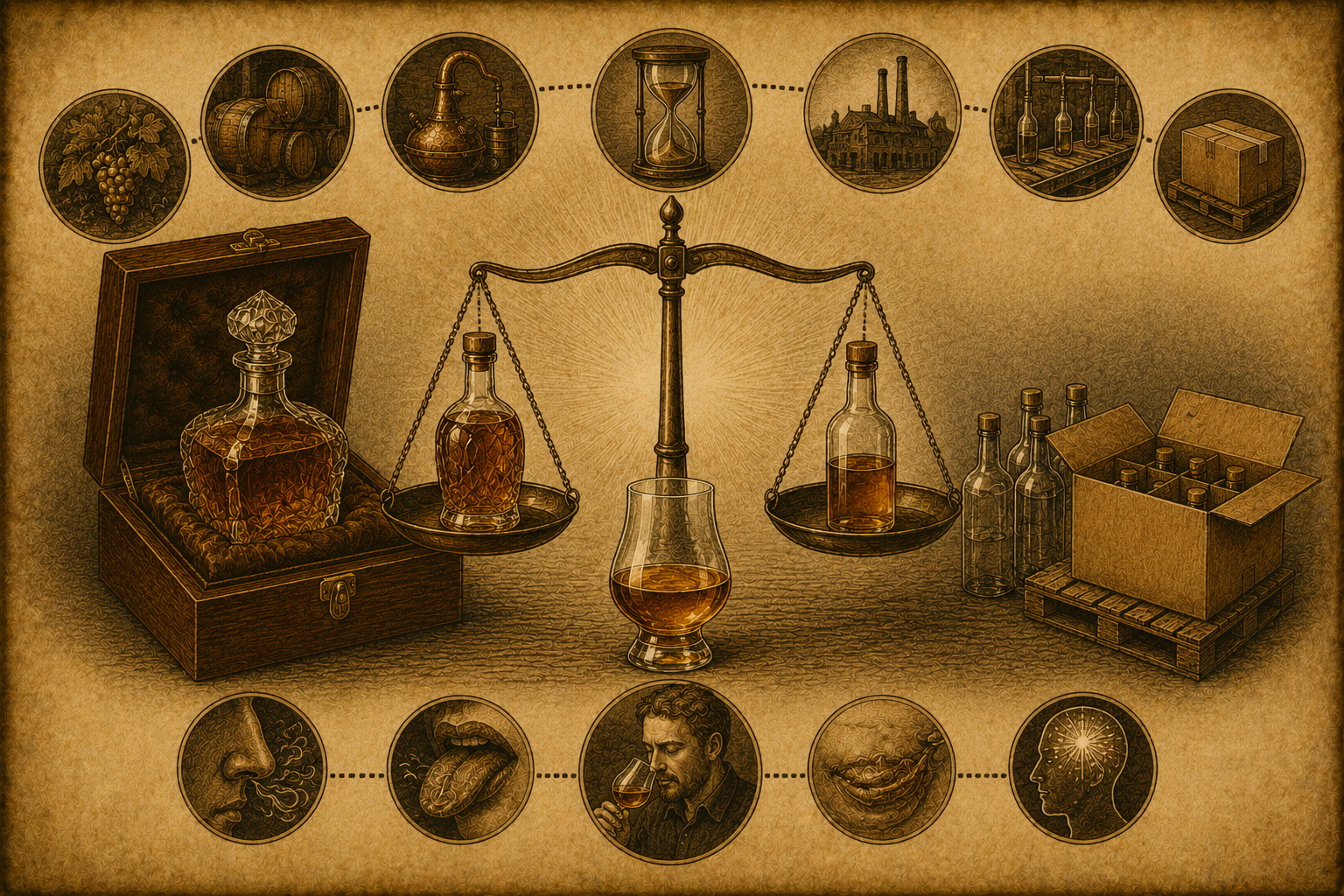
The most expensive bottle on the shelf
Imagine an ordinary store.
There are dozens of bottles on one shelf.
One costs 500 hryvnias.
The other costs 1,500.
There is a bottle nearby for 5,000.
And somewhere in a special display case you can see alcohol, the cost of which is measured in tens or even hundreds of thousands of hryvnias.
Most people automatically make a simple conclusion.
The more expensive the drink, the better it is.
This logic seems so obvious that almost no one questions it.
But if everything is so simple, an interesting question arises.
Why are sometimes experienced tasters happy to choose a bottle of average price category, even when there is a much more expensive alcohol next to it?
The answer is that price and quality are related. But they are far from the same thing.
What are we really paying for?
When a person picks up a bottle, he sees only the finished result.
But behind this bottle can be years of work.
The cost of alcohol consists of many components.
This is high-quality raw materials.
Careful fermentation.
Slow distillation.
Oak barrels.
Years of aging.
Losses during maturation.
Work craftsmen.
Storage.
Bottle.
Cork.
Label.
Logistics.
Taxes.
And only after that does the drink reach the store.
That is why a high price does not always mean overpayment.
Sometimes it simply reflects the complexity of production.
Time also costs money
Let's say a distillery produced a new distillate today.
It could sell it in a few weeks.
Or it could pour it into an oak barrel and wait ten years.
All this time, the money actually remains "frozen".
While the bottle has not yet been sold, the producer does not return the investment.
Moreover, over the years of aging, part of the distillate evaporates - the same phenomenon that we call "angel's share".
As a result, after many years, the finished product becomes smaller, and the costs increase.
All this inevitably affects the final price.
An oak barrel is also an investment
A quality oak barrel has never been cheap.
It requires properly dried oak, the skill of a cooper, precise roasting and a lot of manual work to make it.
A barrel can last for years, but with each new aging it gradually changes and gives off fewer aromatic substances.
Therefore, for certain styles of drinks, manufacturers regularly buy new barrels.
And this also becomes part of cost price.
And where does marketing begin?
It would be wrong to claim that any expensive bottle fully justifies its price.
Sometimes a significant part of the cost is not formed by the drink itself.
Exclusive packaging.
Crystal bottle.
Limited edition.
A well-known brand name.
Advertising.
The story that is told around the product.
All this also has its price.
Sometimes the buyer pays not only for the distillate, but also for emotions, prestige or collector's value.
Is it possible to make excellent alcohol without space prices?
Absolutely.
Many modern distilleries do not strive to create the most expensive product.
They strive to create an honest one.
One in which the money is invested not in a luxurious box, but in high-quality raw materials, precise distillation, a harmonious recipe and careful control of each stage of production.
That is why among drinks in the middle price category you can find real discoveries.
Is the most expensive always the tastiest?
This is where the most interesting part begins.
Taste is a very personal concept.
A person who is just getting acquainted with the world of distillates can get much more pleasure from a young fruit or honey distillate than from a very old drink with a complex woody character.
Experienced a taster, on the contrary, will appreciate dozens of subtle aromatic nuances that a beginner will not even notice.
That is why more expensive alcohol does not always bring more pleasure.
It only offers a different level of complexity.
How do professionals evaluate alcohol?
During professional tastings, bottles are often served "blind".
Tasters do not see the label.
They do not know the manufacturer.
They do not know the cost.
In front of them is only a glass.
And very often it is in such conditions that the influence of price, reputation and beautiful packaging disappears.
Sometimes expensive drinks confirm their status.
Sometimes much more affordable bottles become a real discovery.
That is why professionals trust first of all own feelings.
So what is worth paying for?
The best buy is not the most expensive bottle.
And not the cheapest.
The best buy is alcohol in which the price corresponds to what is inside.
When a manufacturer invests in high-quality raw materials, honest technology, careful work of craftsmen and sufficient time to create a drink, it is almost always felt in the glass.
But a beautiful case by itself has never made the distillate tastier.
Conclusion
More expensive alcohol is not always better. A high price can be a consequence of long aging, expensive oak barrels, rare raw materials or small production volumes. But it can also include marketing costs, prestigious design or collector's value.
True quality is not determined by the number on the price tag, but by how the drink itself is created. The skill of the distiller, selected raw materials, attention to detail and honest production always remain more important than a famous name or luxurious packaging. That is why it is worth choosing alcohol not only with your eyes, but also with knowledge - then each bottle will bring much more pleasure.