





Is it true that craft alcohol is always better?
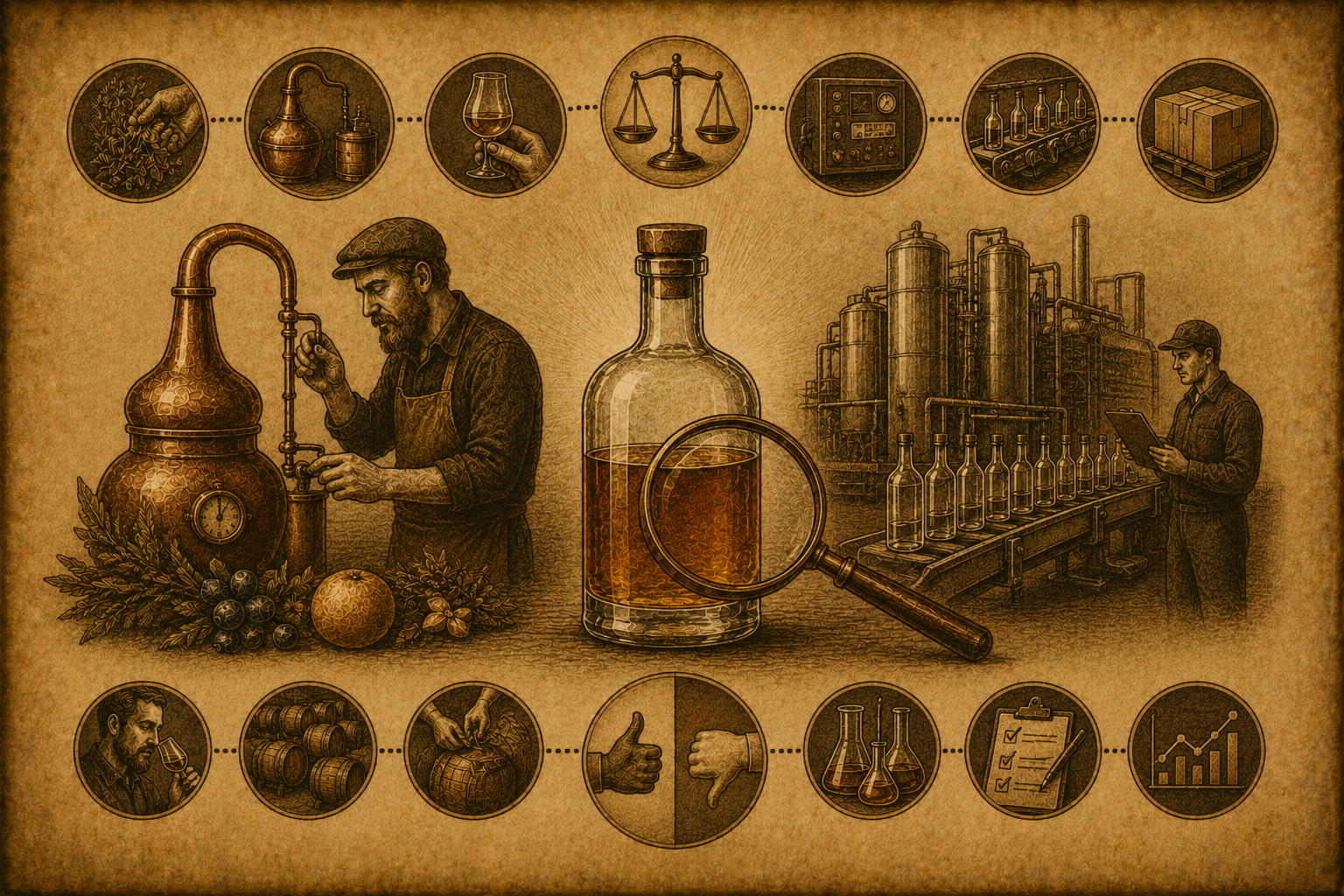
Craft has become a symbol of quality
In recent years, the word “craft” has become almost magical.
It can be seen on bottles, labels, restaurant menus, and even in advertising.
For many buyers, this word is enough to conclude:
“If it’s craft, it’s definitely better.”
But is it really that simple?
What does the word “craft” even mean?
And can the size of a distillery guarantee high quality?
What is craft alcohol?
First of all, it’s worth understanding one important thing.
Craft is not a separate style of alcohol or a special production technology.
Most often it is called drinks that are made in small batches, with great attention to detail and the opportunity to experiment.
It is the freedom from mass production that allows craftsmen to work with bold recipes, unusual raw materials or their own technological solutions.
But freedom does not mean automatic success.
Why is craft often truly impressive?
A small distillery has advantages that large productions sometimes lack.
The craftsman can personally control almost every stage.
Change the recipe after one tasting.
Try a new type of honey.
Experiment with botanicals.
Choose a different type of oak barrel.
All this is much more difficult to do at a company that produces hundreds of thousands of bottles of the same recipe.
That is why many interesting ideas are born in the craft environment.
But small scale is no guarantee of quality
Here lies the main myth.
A small distillery can also make mistakes.
Insufficient control of fermentation.
To rush with distillation.
Choosing the wrong raw materials.
Or simply not having enough experience yet.
In such cases, the label “craft” is not able to make the drink better.
Quality is still determined by knowledge, attention and skill.
Why can large producers also make excellent alcohol?
Sometimes you can hear another extreme:
“Everything industrial is bad.”
This is also a myth.
Many world-famous distilleries have maintained an extremely high level of quality for decades.
They have modern laboratories, experienced technologists, their own aging warehouses and strict control of each batch.
It is thanks to this that the buyer receives a stable taste from year to year.
Such predictability is also a great skill.
So what is the main strength of craft?
It is not that it is automatically better.
But that it can afford to be different.
Small productions are often the first to try new flavor combinations.
They work with local raw materials.
They revive old recipes.
They are not afraid to create limited editions that will never be would not appear in mass production.
Craft is a territory of experiments.
Sometimes they give birth to real masterpieces.
Sometimes - just a valuable experience.
How to choose alcohol then?
The simplest answer is:
Don't buy just the word on the label.
Pay attention to the reputation of the manufacturer.
How he talks about his raw materials.
Openness of technology.
Honesty in details.
And, of course, your own impressions after tasting.
After all, it is the glass, not the advertising inscription, that always gives the final assessment.
What unites good craftsmen?
If you look closely at the best distilleries in the world, they have one thing in common.
They can be very small or very large.
Work for centuries or only a few years.
But they all respect the raw materials.
They take their time with production.
They control every stage.
They are constantly learning.
This is what creates quality.
Not the number of employees.
Not the production area.
And not even the word "craft".
Conclusion
Craft alcohol is not always better than industrial alcohol, just as industrial alcohol is not always inferior to craft alcohol. Both approaches can yield excellent results if they are backed by experience, honest technology, and respect for the raw materials.
The real advantage of craft lies elsewhere—in the freedom to experiment, create unique recipes, and put a personal touch into each batch. And quality comes not from the scale of production, but from the skill of the people who create the drink. That is why the best alcohol is not the one that says “craft,” but the one that is made with attention, knowledge, and love for its craft.