





Can you determine the quality of alcohol by color?
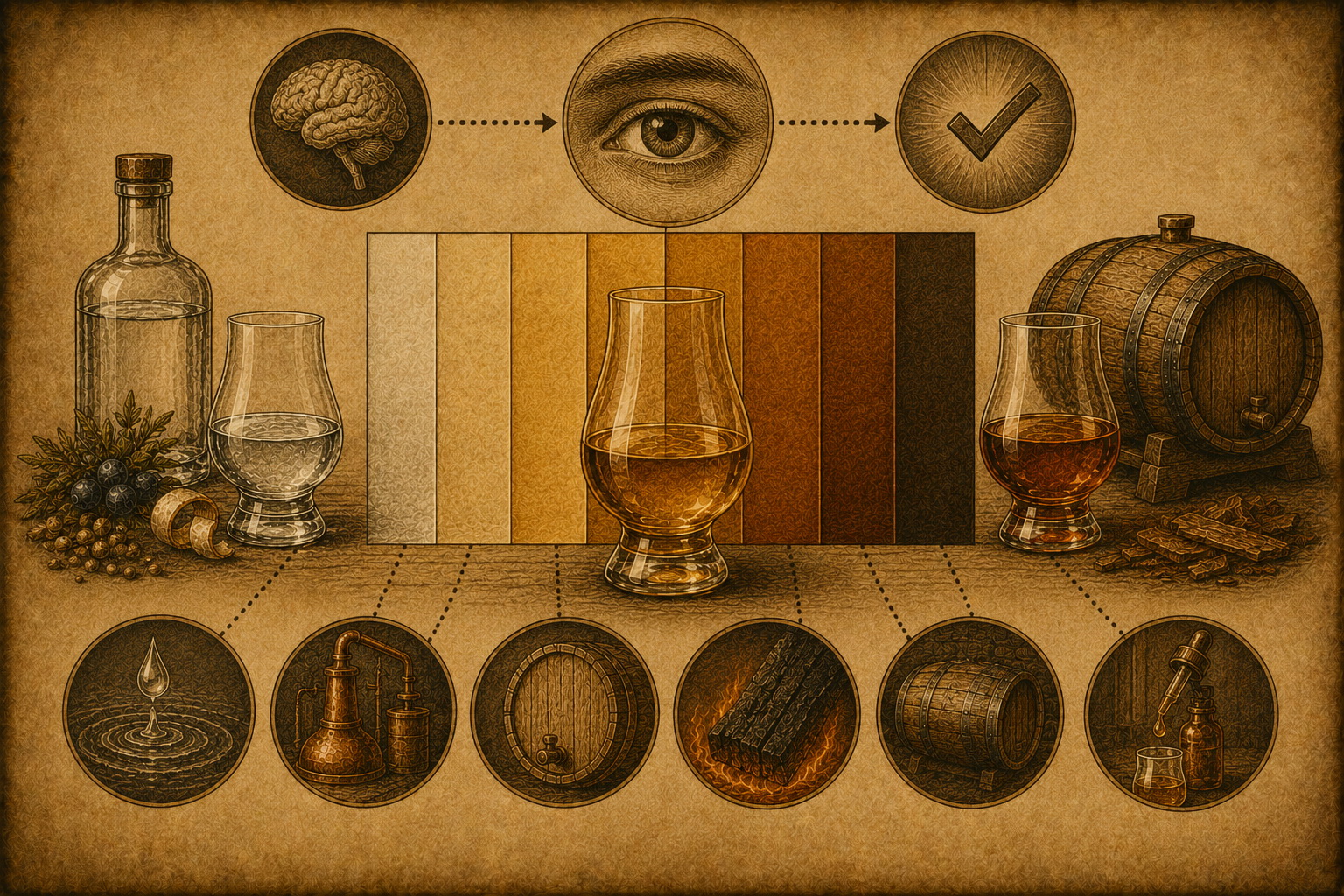
We taste with our eyes first
A person has not yet opened the bottle.
Has not inhaled the aroma.
Has not taken the first sip.
But the brain has already begun to evaluate the drink.
This happens automatically.
We look at the color and almost instantly draw conclusions.
Dark amber seems noble.
Golden - soft.
Transparent - young.
That is why manufacturers know: the first acquaintance with alcohol does not occur through taste.
It begins with the eyes.
But can we trust this first impression?
Why does the dark color seem better?
Interestingly, this effect works not only with alcohol.
Darker chocolate seems richer.
Darker coffee is stronger.
A golden crust on bread is tastier.
Our brains often associate rich color with maturity, complexity, and high quality.
That's why a dark distillate subconsciously inspires more trust than a completely clear one.
But nature doesn't always live up to our expectations.
What does color really say?
Color can tell you a few things.
For example, it's likely that the distillate has been in contact with an oak barrel or other wood.
It can be assumed that it has been aged for a certain time or has undergone additional processing.
Sometimes the shade suggests the degree of roasting of the barrel or even its previous use.
But these are all just clues.
Not a final conclusion.
What can't color say?
This is where the most important thing begins.
Color cannot answer the main questions.
What was the raw material?
How successful was the fermentation?
Was the distillation done correctly?
Is the aroma clean?
Is the taste harmonious?
Is there a long aftertaste?
None of these answers are in color.
Two bottles may look almost the same, but inside they hide a completely different level of craftsmanship.
Dark does not mean old
We already know that the color of the distillate is born during the interaction with wood.
But the speed of this process depends on many factors.
A new barrel dyes more actively.
A small barrel works faster.
A strong roasting adds more color.
A warm climate accelerates extraction.
As a result, a young distillate can sometimes look darker than one that has been aged much longer.
That is why experienced tasters never determine the age only by the shade in the glass.
Transparent does not mean simple
An equally common and opposite myth.
If the drink is transparent, then it is supposedly less noble.
But then an interesting thing arises question.
Why do the best gins in the world remain transparent?
Why is Blanco tequila highly valued by connoisseurs?
Why don't they try to make fruit eau de vie amber?
The answer is simple.
Because their strength lies not in oak, but in the purity of the aroma.
For them, color would not be an advantage, but an interference with the master's plan.
Can the color be artificially changed?
Yes.
And this is another reason not to jump to conclusions.
In some categories of alcohol, manufacturers have the right to use natural caramel coloring to adjust the shade.
It is added not to change the taste, but so that different batches of the same product look equally.
After all, each barrel works in its own way, and without such adjustment, bottles of the same brand could differ noticeably from each other.
Therefore, even a very beautiful amber color does not tell the whole story of the drink.
How do professionals evaluate alcohol then?
Color really matters.
But only as the first stage.
Professional tasting almost always takes place in the same sequence.
First, the appearance is evaluated.
Then the aroma.
After that, the taste.
And only at the end, the aftertaste and overall impression.
If color could tell everything, the rest of the stages would simply not exist.
But it is the aroma and taste that determine the true level distillate.
Why do we still look at color?
Because it's beautiful.
The light that passes through an amber glass creates a special mood.
Golden highlights emphasize the character of the aged drink.
Crystal clear gin speaks of freshness and purity.
Color helps us tune in to the tasting.
But it shouldn't make the decision for us.
Conclusion
The color of alcohol can tell a lot to the attentive observer. It can tell about the contact with oak, the approximate nature of the aging process, or the peculiarities of production. But it will never show the main thing - how well the drink itself is created.
True quality is determined by aroma, taste, balance, and aftertaste. These remain the main criteria for professional tasters. Therefore, a beautiful amber hue should be perceived as an invitation to get acquainted, and not as definitive proof that you have a great distillate in front of you.