





Why Is Copper Used in Distillation Equipment?
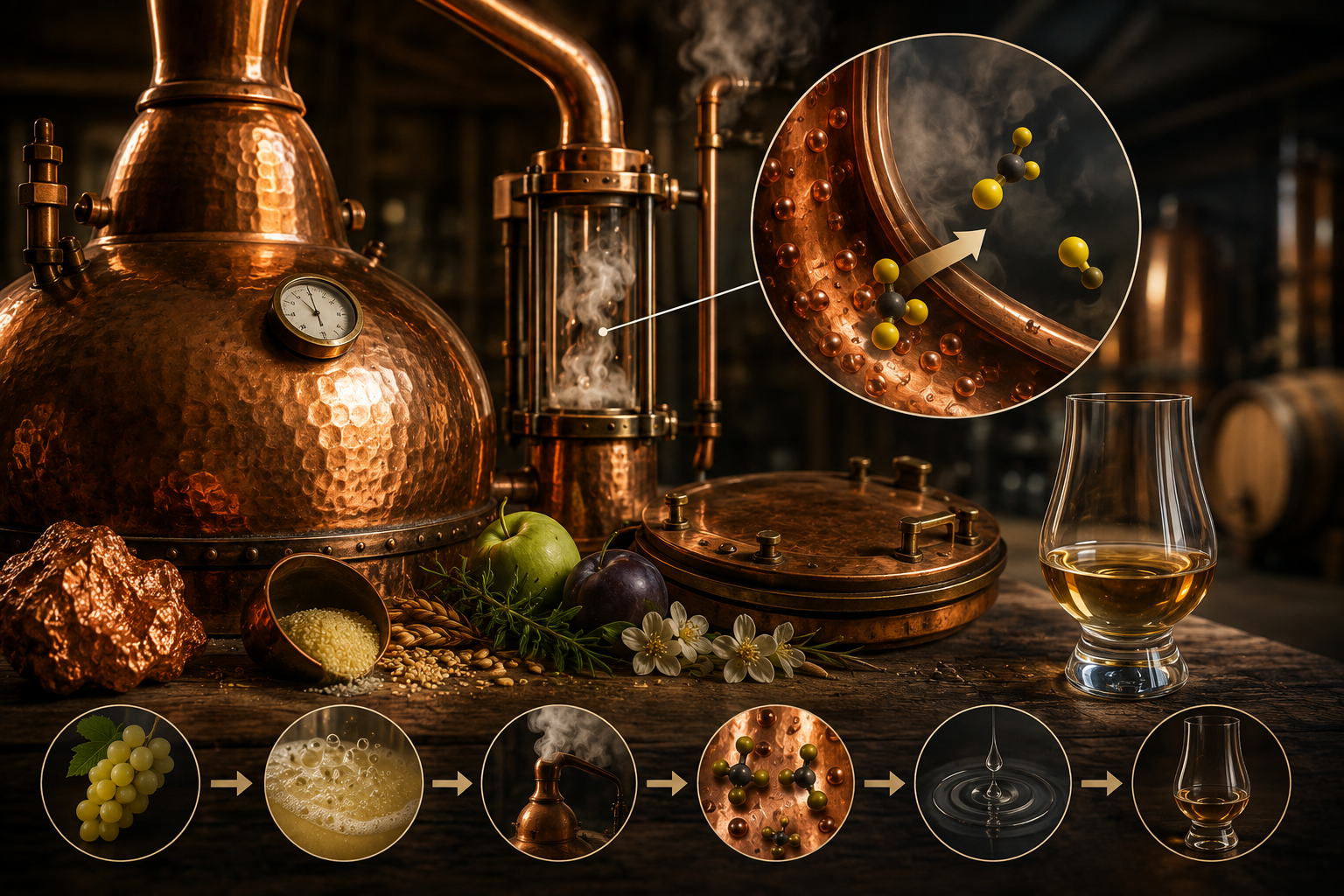
If you look at traditional stills used to produce Cognac, whisky, fruit brandies, and other distillates, you will often see a distinctive reddish-golden metal: copper.
Copper stills have been used for centuries. At first glance, it might seem that this is simply a legacy of old technology — stills were once made from copper, so the tradition has survived into the modern era.
But the reason is much more interesting.
Copper does more than provide the structure of a still. It can actively influence the purity and aromatic profile of the resulting distillate.
This is why even modern distilleries, where much of the equipment is made from stainless steel, often deliberately include copper components in areas where alcoholic vapors come into contact with the equipment.
Why Were Stills Historically Made from Copper?
For distillers of previous centuries, copper offered several important advantages at once.
It:
- conducts heat efficiently;
- is relatively easy to shape and work with;
- can be formed into complex rounded structures;
- is sufficiently durable when properly maintained;
- can be repaired relatively easily;
- has properties that are particularly useful during distillation.
Sheets of copper could be shaped into large boilers, domes, necks, and vapor pipes.
This led to the development of the classic copper alembic and pot still, designs that in some regions have changed remarkably little over the centuries.
What Makes Copper Special from a Chemical Point of View?
One of copper’s most interesting properties becomes apparent when it comes into contact with vapors from fermented raw materials.
Fermentation produces more than ethanol and desirable aromatic compounds.
It can also create a variety of sulfur-containing compounds.
Some of these have extremely intense and undesirable aromas.
Even at relatively low concentrations, they may create associations with:
- cooked vegetables;
- cabbage;
- onions;
- rubber;
- matches;
- other sharp sulfur-like odors.
Copper can interact with some of these compounds.
This is one of the main reasons why it remains so valuable in the production of aromatic distillates.
How Does Copper Help Reduce Sulfur Aromas?
When alcoholic vapors come into contact with a copper surface, some sulfur-containing compounds can react with the metal.
As a result, these substances may be transformed into other compounds and retained on the copper surface rather than passing into the final distillate in the same amount.
This is also one reason why copper surfaces inside distillation equipment gradually change appearance and require proper cleaning and maintenance.
In this sense, copper acts as an active participant in the treatment of the vapor rather than simply as a container for the process.
Does Copper Work Like a Filter?
Not exactly.
A conventional filter physically traps certain particles.
Copper works differently. Its effect involves chemical interactions between the metal surface and certain compounds present in the vapor.
It is therefore more accurate to talk about the chemical reactivity of copper rather than mechanical filtration.
For distillation, that distinction is important.
Does Copper Affect the Aroma of a Distillate?
Yes, but not because it is supposed to give the spirit a “copper flavor.”
When the process is properly controlled, the finished distillate should not taste metallic.
Much of copper’s influence comes from its ability to help reduce certain undesirable aromatic compounds.
As a result, other aromas may become cleaner and easier to perceive.
Fruit, floral, grain, herbal, or honeyed notes, for example, may appear more clearly when they are not obscured by strong sulfur-related aromas.
Can Copper Turn Poor Raw Material into a Good Distillate?
No.
A copper still cannot correct every mistake made during earlier stages of production.
The quality of a distillate begins much earlier, with the selection and preparation of the raw material.
Important factors include:
- the quality of honey, fruit, grain, or other raw materials;
- equipment hygiene;
- proper fermentation;
- yeast performance;
- temperature control;
- fraction selection;
- the way the distillation itself is managed.
Copper is only one tool within a much larger technological process.
Why Isn't All Modern Distillation Equipment Made Entirely from Copper?
Copper has disadvantages as well as advantages.
In modern production, stainless steel is often considerably more practical.
It is:
- very strong;
- highly resistant to corrosion;
- durable;
- relatively easy to maintain hygienically;
- well suited to large industrial systems.
For this reason, modern distillation equipment often combines both materials.
Tanks, structural sections, and some pipework may be made from stainless steel, while copper components are installed in areas where vapor contact is considered beneficial.
Copper or Stainless Steel: Which Is Better for Distillation?
There is no universal answer.
The two materials have different properties.
Stainless steel is practical, strong, and relatively chemically neutral under normal operating conditions.
Copper requires more maintenance but can actively interact with certain compounds in the vapor.
Modern distillation therefore does not always involve choosing “copper or stainless steel.” In many cases, the most effective solution is to combine the two.
Does the Entire Still Have to Be Made from Copper?
No.
What matters technologically is sufficient and properly positioned contact between the alcoholic vapor and copper.
This is why some stills are constructed mainly from stainless steel but contain:
- copper plates;
- copper bubble caps;
- copper packing;
- copper column sections;
- other copper contact elements.
This allows a producer to combine the practical advantages of stainless steel with the chemical properties of copper.
Where Is Copper Contact Especially Important?
The amount of copper in a still is not the only factor. Its location matters as well.
Contact can be especially important in the vapor path, where hot vapors travel from the boiler toward the condenser.
This is where volatile compounds come directly into contact with the metal surface.
For this reason, copper domes, necks, plates, and other components in the vapor path can have significant technological importance.
Does the Surface Area of Copper Matter?
Yes.
The greater the active copper surface exposed to vapor, the more opportunity there is for relevant chemical interactions.
This is why column equipment may contain specially designed copper packing with a large surface area.
However, the idea that “more copper is always better” is also too simplistic.
The final result depends on the entire equipment design, vapor flow, operating conditions, and the nature of the fermented raw material.
Why Do Traditional Alembics Have Such Unusual Shapes?
The dome, long neck, and curved vapor pipe are not simply decorative.
The shape of a still influences how vapor behaves inside it.
Some vapor can condense on the internal surfaces, flow back down, and evaporate again.
This creates a degree of natural reflux.
Tall, narrow necks generally encourage more of the heavier components to return to the boiler.
Shorter or broader designs may allow more heavier aromatic compounds to continue toward the condenser.
Copper and still geometry therefore work together.
Why Can Two Copper Stills Produce Different Spirits?
Because the material is only one part of the equation.
The result also depends on:
- boiler volume;
- the shape of the dome;
- neck height;
- pipe diameter;
- the angle of the vapor line;
- heating rate;
- cooling intensity;
- the rate at which distillate is collected.
Two stills made from the same type of copper can therefore produce noticeably different aromatic profiles.
Can the Shape of a Still Become Part of a Distillery's Style?
Yes.
At some long-established distilleries, the shape of the stills is preserved for decades.
When an old still eventually has to be replaced, the new one may be reproduced as closely as possible.
The reason is simple: even relatively small changes in geometry can affect reflux, copper contact, and the composition of the resulting distillate.
The still itself can therefore become part of the spirit's production identity.
Is Copper Used in Column Stills?
Yes.
Distillation and rectification columns are often constructed mainly from stainless steel, but copper components may be installed inside them.
These may include plates, packing, bubble caps, or entire sections of the column.
This allows modern equipment to retain the benefits of an efficient industrial design while still providing controlled contact between vapor and copper.
Is Copper Used in Gin Production?
Copper equipment is also widely used in gin production.
This is particularly true for distilled gin, where an alcoholic base is redistilled with juniper and other botanicals, or where the vapor interacts with botanical ingredients during distillation.
The cleanliness of the alcoholic base and control of undesirable aromas are especially important here because unwanted notes can interfere with delicate citrus, herbal, floral, and spicy botanical aromas.
Why Is Copper Particularly Interesting for Honey Distillates?
After fermentation, honey can create a complex aromatic base.
Depending on the raw material and fermentation, it may contain floral, fruity, herbal, waxy, and spicy nuances.
The purpose of distillation is to preserve interesting characteristics of the raw material while reducing undesirable harsh notes.
Copper contact can help produce a cleaner aromatic profile without necessarily turning the distillate into completely neutral alcohol.
That balance is particularly important for spirits where the origin and character of the raw material are meant to remain part of the final drink.
Can Copper Influence the Spirit After Barrel Aging?
Indirectly, yes.
The spirit entering the barrel has already developed much of its fundamental character during fermentation and distillation.
If its aromatic profile is clean and balanced, it will interact with oak differently from a distillate containing excessive undesirable compounds.
A barrel does not simply “fix” a spirit.
Instead, maturation develops and transforms what the producer created during earlier stages.
This is why distillation quality matters long before the spirit spends its first day in oak.
Why Does Copper Become Darker?
New copper has a distinctive bright reddish appearance.
During operation, its surface comes into contact with oxygen, moisture, and various compounds present in the vapor.
Different substances gradually form on the surface, changing the appearance of the metal.
This is a natural consequence of copper's chemical activity.
For that reason, distillation equipment requires regular professional cleaning and inspection.
Why Is Proper Maintenance of Copper Equipment Important?
Copper's chemical activity is one of its greatest advantages.
But the same property means its surface cannot simply be ignored.
Deposits and reaction products gradually accumulate during use.
If the equipment is not maintained correctly, the condition and effectiveness of the copper contact surfaces can change.
Proper sanitation and maintenance are therefore part of maintaining a stable and repeatable production process.
Does Copper Get into the Finished Spirit?
In properly designed and correctly operated professional equipment, the production process is controlled so that the finished product meets applicable safety and composition requirements.
The purpose of using copper is not to add metal to the beverage. Its purpose is to provide appropriate contact between vapor and the equipment surface.
This is why equipment condition, cleaning, and process control are essential parts of professional distillation.
Can You Produce a Good Distillate Without an All-Copper Still?
Yes.
Modern distillation is not limited to traditional stills made entirely from copper.
High-quality distillates can be produced using equipment that combines stainless steel and copper.
More important than the external appearance of the still are:
- proper equipment design;
- sufficient copper contact where it is needed;
- controlled distillation conditions;
- high-quality fermented raw material;
- careful fraction selection.
Does a Copper Still Automatically Mean High Quality?
No.
A beautiful polished copper still may look impressive in photographs, but the material alone cannot guarantee a high-quality spirit.
Copper gives the producer certain technological advantages.
The final result depends on how those advantages are used.
Raw materials, fermentation, still design, distillation conditions, fraction selection, maturation, and blending all form part of the same production process.
Copper in Distillation: In Short
- Copper conducts heat efficiently and is well suited to the construction of traditional stills.
- It can interact with certain sulfur-containing compounds formed during fermentation.
- This can help reduce undesirable harsh aromas.
- Copper should not give a properly produced spirit a metallic taste.
- The entire still does not need to be made from copper for copper contact to have a technological effect.
- Modern equipment often combines stainless steel with copper contact components.
- Still geometry and the surface area of copper contact also influence the result.
- A copper still alone does not guarantee the quality of a distillate.
Conclusion
Copper stills became a symbol of distillation for reasons that go far beyond tradition.
Behind the beautiful shine of a copper alembic lies practical chemistry and centuries of accumulated production experience.
Copper conducts heat well and can be shaped into complex equipment, but its most important property for distillation is its ability to interact with some undesirable sulfur-containing compounds created during fermentation.
This can help make the aromatic profile of a distillate cleaner and allow the character of the original raw material to become more expressive.
Modern distilleries may use stainless steel, automated controls, and sophisticated column systems, yet copper continues to play an important role in many forms of distillation.
And there is something fitting about that.
One of the oldest materials associated with the art of distillation remains relevant not simply because previous generations used it, but because its properties still help shape the character of modern spirits.