





Why did gin become popular in the world?
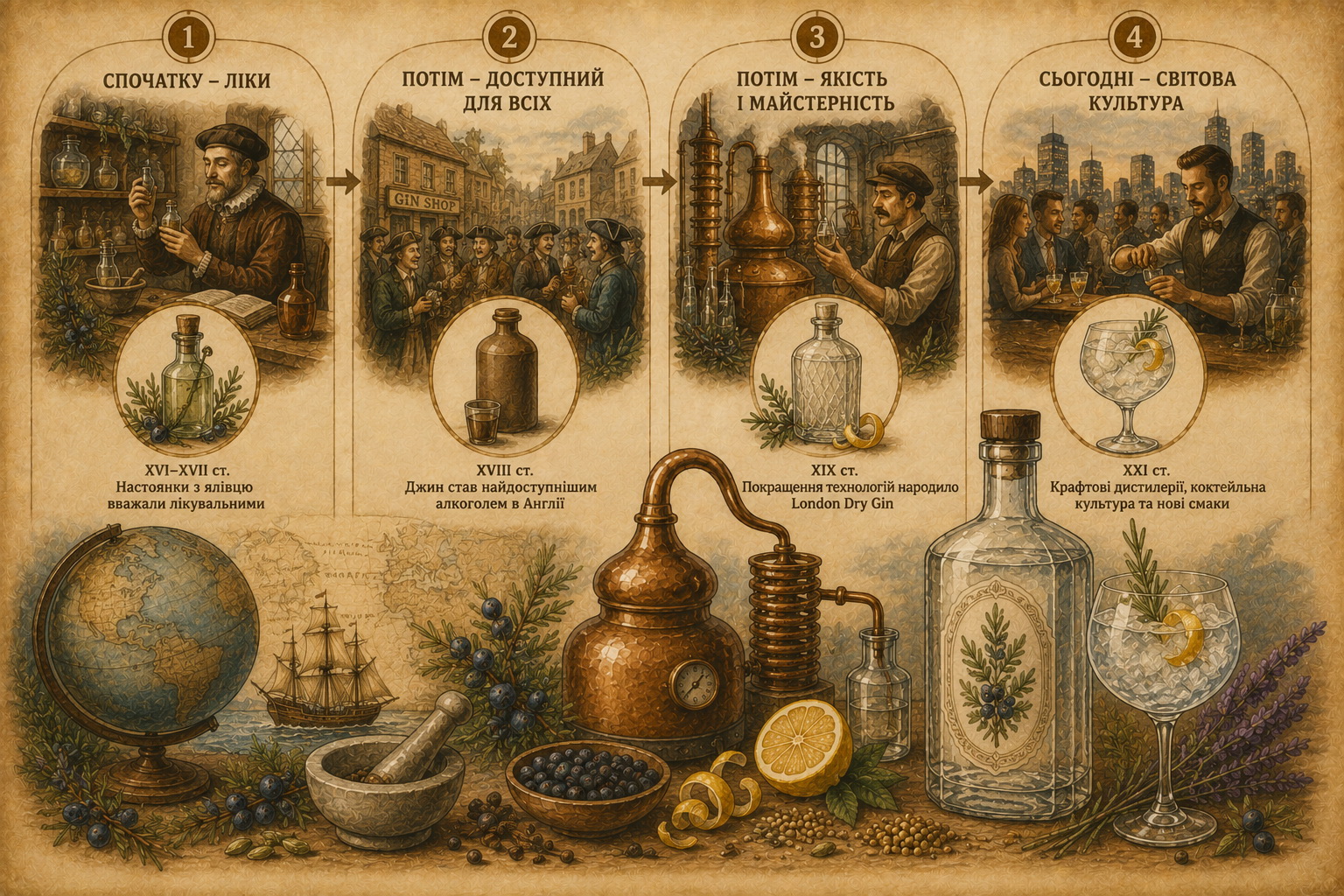
Popularity that was born four times
Most famous drinks experience one period of great success. Gin was an exception.
Over the centuries, it has repeatedly changed its role. First, it was considered a medicine, then the most affordable alcohol for the poor, later almost a social problem, and today it is among the most respected drinks in the world.
Its popularity was not accidental. It was born again and again, each time for a completely different reason.
The first success - when gin was a medicine
The first tinctures on juniper appeared long before modern gin. They were prepared by pharmacists and doctors who believed that juniper berries help maintain health, improve digestion and have healing properties.
Of course, the medicine of that time was significantly different from modern medicine. But it was thanks to these tinctures that people first discovered the unusual combination of grain alcohol and juniper aroma.
This is how the story of a drink that no one has yet called a world classic began.
The second success - when gin became a drink for everyone
In the late 17th and early 18th centuries, England experienced a real "gin boom". Gin was relatively easy to produce, it was cheap, and demand grew at an incredible speed.
It was drunk everywhere - from city taverns to small shops. For many people, it was the most affordable alcohol.
But popularity also had a downside. Excessive consumption led to serious social problems. Restrictions, new laws, and even high-profile campaigns against gin appeared.
Paradoxically, it was this difficult page of history that made it one of the most famous drinks in Europe.
The third success - when quality won over quantity
Later, alcohol production began to improve rapidly. Distillers became more precise, alcohol became purer, and distillers learned to work with botanicals much more delicately.
It was then that the style that we know today as London Dry Gin was born.
Gin ceased to be just cheap alcohol. It became a complex aromatic drink, in which juniper, citrus, coriander, angelica and other plants played the main role.
It was during this period that gin's reputation as a noble distillate was formed.
The fourth success - the era of cocktails
If history had ended with London Dry Gin, gin would undoubtedly have remained popular. But the real global breakthrough came a little later.
Bartenders understood one very important thing. Gin does not try to dominate other ingredients. It creates a foundation for them.
That is why dozens of cocktails appeared, which are known all over the world today: Gin & Tonic, Martini, Negroni, Tom Collins, Aviation, Gimlet and many others.
Each of them opened a new side of the same drink.
Why gin?
There are many spirits in the world, but gin has one feature that is almost not found in other categories.
It is extremely flexible.
By changing the set of botanicals, the distiller can create a completely different character of the drink without losing its essence. One gin surprises with coniferous freshness, another with citrus lightness, the third with floral or spicy shades.
It is this freedom that allows each distillery to tell its own story in the language of aromas.
Modern gin is more than a cocktail
Twenty years ago, many perceived gin only as an ingredient for mixed drinks. Today, the situation has changed.
A culture of slow tasting is rapidly growing in the world. People are increasingly interested in the origins of botanicals, the work of the master distiller, the peculiarities of the recipe and the local plants that give each gin its individual character.
Craft distilleries have opened a new page in the history of this drink, proving that gin can be no less complex and multifaceted than whiskey or cognac.
Conclusion
Gin did not become popular because it got lucky once. Its history consists of several completely different eras, in each of which people discovered this drink in a new way.
At first it was valued as a medicinal tincture. Then it became a drink for the general population. Later it became a symbol of high-quality distillation, and today it is one of the most interesting platforms for the creativity of distillers around the world.
Perhaps that is why gin still does not lose its popularity. It is constantly changing, but it never loses its main character - the fresh aroma of juniper, with which its history once began.