





What is "angel's share"?
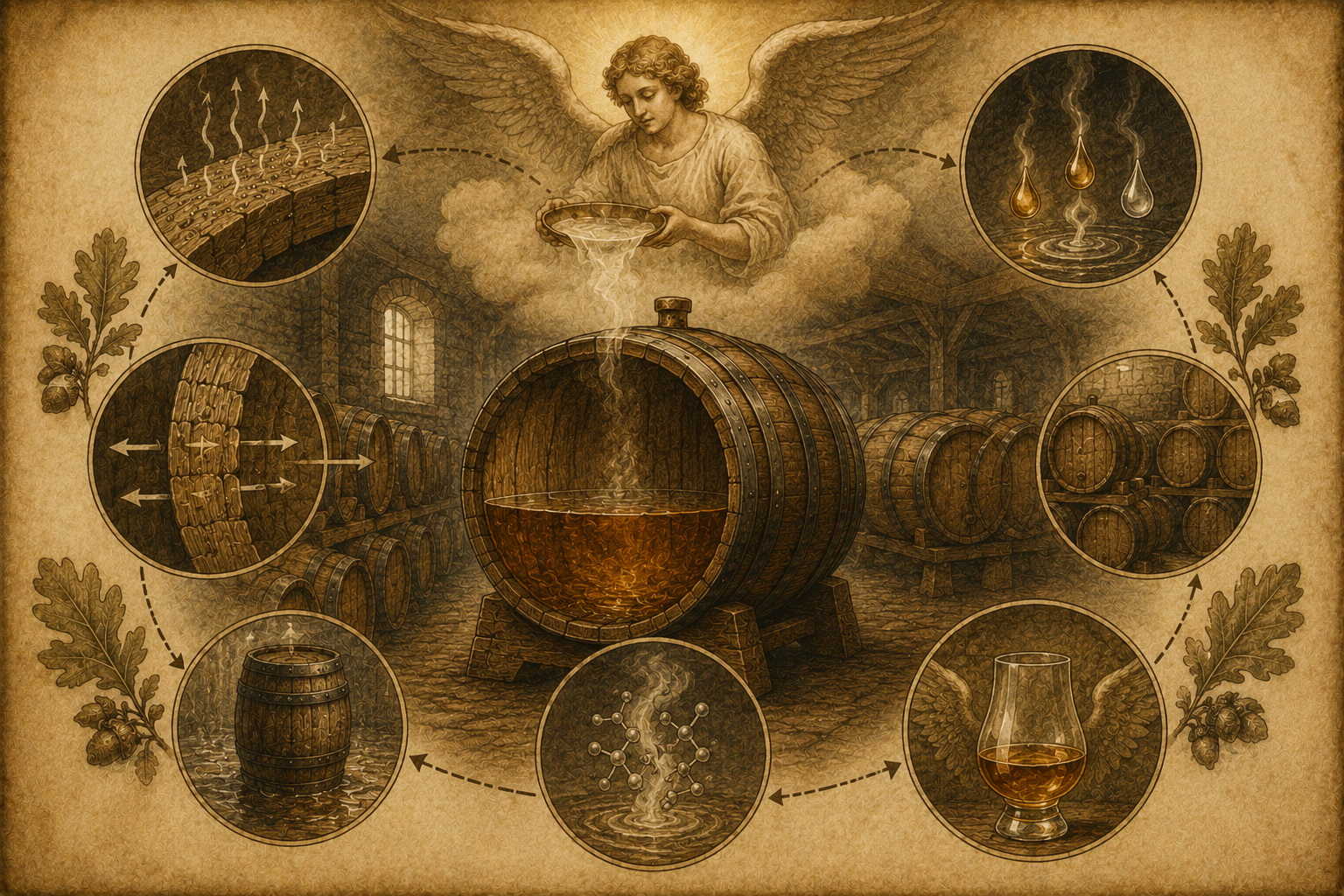
Where does the distillate go if the barrel doesn't leak?
Imagine an old warehouse filled with rows of oak barrels. It's quiet. No one opens the lids, no one pours the drink, no one touches the wood.
A year has passed.
Then the second.
The fifth.
The tenth.
And when the master finally opens the barrel, he almost always sees the same picture.
There is less distillate.
Not by one or two glasses.
Sometimes dozens of liters disappear.
At the same time, the barrel is completely in working order.
It does not leak.
No one stole anything.
So where did the drink go?
A gift to the angels
A few centuries ago, distillers could not explain why Every year the barrels become lighter.
They only saw the result.
There was less liquid.
Thus a beautiful legend was born.
Allegedly, a small part of each barrel is taken by angels. Not as a punishment or as a payment, but as their share for the patience of a person who waits for years for the drink to mature.
This is where the expression “angels’ share” comes from.
Today we know that the reason is not mystical at all. But the name turned out to be so successful that it is used by distillers all over the world.
In fact, the barrel is constantly breathing
An oak barrel only seems airtight.
If you look at the wood under a microscope, it resembles a complex system of natural channels and pores.
It is through them that one of the most important features of aging occurs.
The barrel slowly exchanges air with the environment.
A very small amount of oxygen gets inside, and some of the volatile components of the distillate gradually leave the barrel.
It is this slow and almost imperceptible process that is called evaporation.
Does only alcohol evaporate?
This is one of the most common mistakes.
In fact, both alcohol and water.
But their ratio depends on the conditions in which the barrels are stored.
If the air is dry, water evaporates faster. The strength of the drink may even gradually increase.
If the humidity in the storage is very high, alcohol evaporates faster. Then the percentage of alcohol, on the contrary, decreases.
That is why distillates of the same age, aged in different countries, can differ significantly in strength.
Why does climate change everything?
Temperature and humidity determine the nature of aging no less than the barrel itself.
In a cool climate, processes occur more slowly. Annual losses may be relatively small, but the distillate develops very smoothly.
In warm regions, wood reacts more actively to temperature changes. The barrel "breathes" more, and evaporation occurs much faster.
That is why distillates aged in different parts of the world, even for the same number of years, can have completely different characteristics.
Why don't distillers combat these losses?
At first glance, everything seems illogical.
If the precious distillate evaporates every year, why not just make a completely airtight container?
The answer is very simple.
With evaporation, not only part of the liquid disappears. There is a slow gas exchange that helps the drink change. This is why the sharp alcohol notes gradually soften, the aroma becomes deeper, and the taste more harmonious.
If the barrel were completely airtight, the distillate would hardly mature.
It would simply be stored.
How much can an angel's share "take away"?
There is no exact figure.
It all depends on the climate, humidity, temperature, barrel size, type of wood, and aging duration.
On average, losses can amount to several percent per year. It seems like a small amount.
But aging is a marathon, not a sprint.
After ten, fifteen, or twenty years, the total losses become very noticeable.
That is why there are always significantly fewer old distillates than young ones. Part of their volume has long been "received by angels."
Why do old drinks cost more?
When people see the high price of an aged distillate, they often think only of the years of waiting.
But waiting is only part of the story.
Imagine that a distillery filled a hundred identical barrels.
After many years, each of them will have less drink left than it did at the beginning. Part of the volume will be taken away by evaporation, some barrels may not reach the desired quality, and some are used for blending.
As a result, the finished product becomes much smaller.
That is why aged distillate is always a combination of time, risk, and natural losses.
The most expensive component of aging
There is one interesting thought that experienced craftsmen often repeat.
They say that the biggest investment in an aged distillate is not the oak barrel or even the alcohol.
The most expensive thing is patience.
Every year, a distiller sees part of his work literally disappear into thin air. But he accepts these losses because he knows that without them, the complex, deep aroma for which the whole process began will not be born.
Conclusion
“A share of angels” is not a legend about supernatural forces, but a beautiful poetic explanation of an absolutely real phenomenon. The oak barrel constantly “breathes”, allowing the distillate to slowly interact with the environment. At the same time, some of the liquid inevitably evaporates.
For the distiller, this means a smaller volume of the finished product. For the connoisseur, it is another reminder that great drinks are born not in spite of time, but thanks to it. And, perhaps, it is this invisible sacrifice that makes each bottle of aged distillate truly special.