





Acacia, linden or May honey - what's the difference?
Honey that is never the same
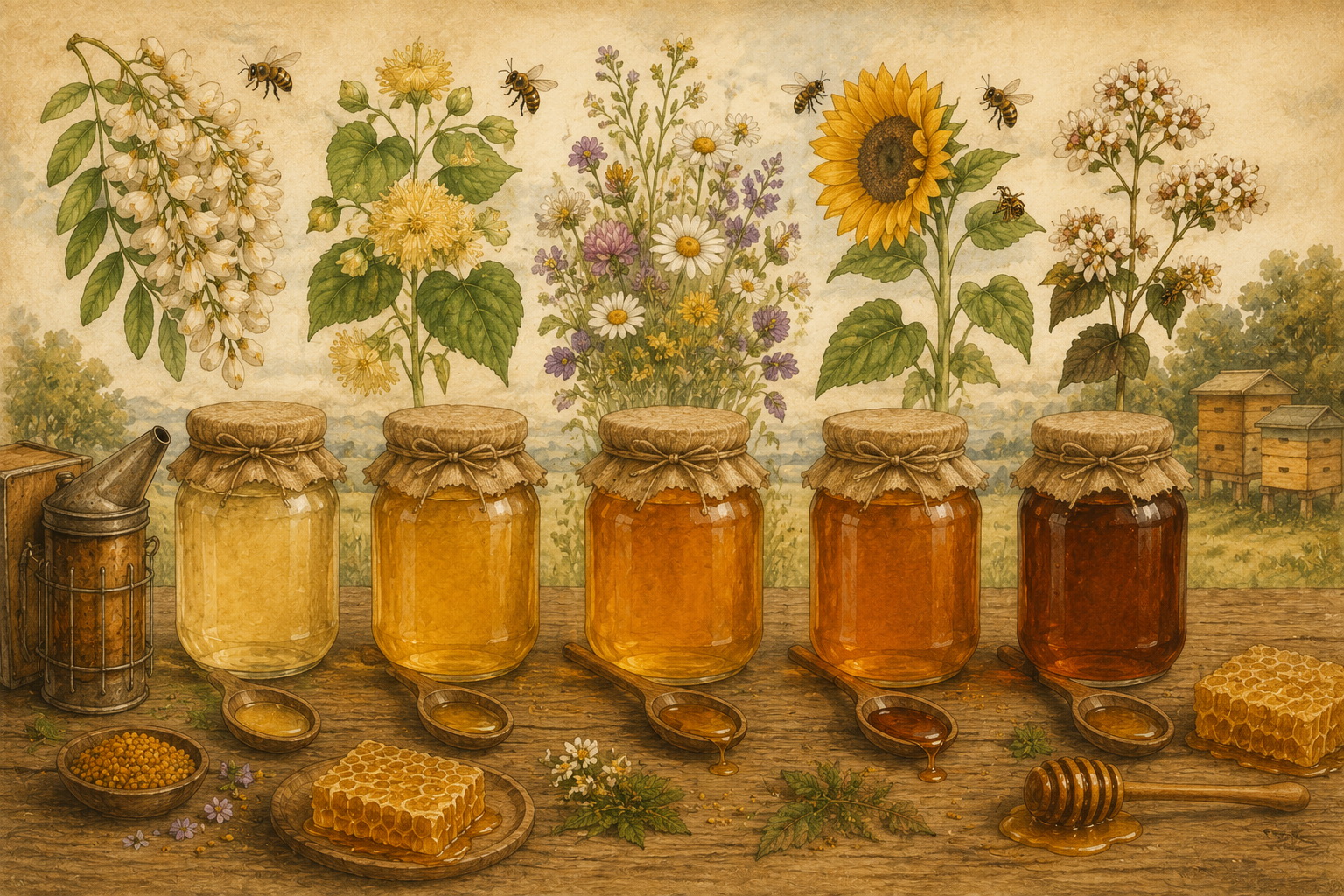
If you put several jars of honey next to each other, even a person who has never been interested in beekeeping will immediately notice the difference. One honey is almost transparent, another has a golden hue, a third is amber, and buckwheat can be almost dark brown. It is not only the colors that differ. It is enough to open the lid to feel: each honey has its own aroma, character and even mood.
Why is this so? Do bees really produce different honey? In fact, the secret is much more interesting. Bees always do the same job. Only where they bring nectar from changes.
Each flower leaves its own signature
Plants produce nectar in order to attract pollinators. But along with sugars, they contain hundreds of natural aromatic compounds. They determine why acacia smells delicate and light, linden - warm and floral, and buckwheat has a recognizable rich aroma.
Bees collect this nectar, process it in the hive, and thus honey is born, which retains part of the character of the plant from which it all began.
What is monofloral honey?
You can often hear the expression "acacia honey" or "linden honey". This does not mean that the bees flew to only one plant. In nature, this is almost impossible.
Monofloreal honey is called honey in which the nectar of one plant predominates. If during the flowering of acacia it is the main source of nectar, the honey acquires the characteristic properties of acacia. The same applies to linden, sunflower or buckwheat.
What is May honey?
This is one of the most common mistakes among buyers. Many people believe that “May” is a separate type of honey. In fact, it is the name of the first large harvest of the season.
Such honey can include nectar from fruit trees, dandelions, rapeseed, garden flowers, meadow plants and other spring honey plants. Its composition depends on the region, weather and what exactly was blooming at a particular moment.
That is why two May honeys from different regions of Ukraine can be completely different from each other.
Acacia honey - lightness and elegance
Acacia honey is easy to recognize by its very light color and delicate aroma. It remains liquid for a long time due to the special ratio of natural sugars and has a mild taste without sharp astringency.
It is often chosen by people who are just starting to get acquainted with natural honey, because it seems especially light and delicate.
Linden honey - the aroma of summer
Linden honey has a more expressive character. It is easy to recognize floral, herbal and light menthol notes in it. It is this honey that many people associate with warm summer evenings, the aroma of flowering alleys and homemade tea.
Its aroma remains one of the most recognizable among all varieties.
Buckwheat honey - character from the first breath
Buckwheat honey is difficult to confuse with any other. Dark color, rich aroma, light spiciness and characteristic astringency make it special. Some fall in love with it from the first spoon, while others need time to appreciate its complex taste.
These varieties best show how diverse natural honey can be.
Sunflower and mixed grass honeys are familiar to almost everyone
Sunflower honey is one of the most common in Ukraine. It crystallizes quickly, has a bright golden color, and a pleasant, mild aroma.
Mixed grass honey is completely different. Its composition changes every year, as it depends on the dozens of plants that bloomed near the apiary. That is why even experienced beekeepers often say that no two identical mixed grass honeys simply exist.
Why is one honey liquid, while the other quickly thickens?
Many people consider crystallization to be a sign of a poor-quality product. In fact, it is quite the opposite. Natural honey almost always thickens over time.
The speed of this process depends on the natural ratio of fructose and glucose. For example, acacia honey can remain liquid for a very long time, while sunflower or rapeseed honey can crystallize in just a few weeks.
Which honey is the best?
There is no right answer to this question. Each variety is created by nature for connoisseurs of different aromas and tastes. Some like the delicacy of acacia, some like the floral warmth of linden, and some cannot imagine honey without the bright character of buckwheat.
It is this diversity that makes the world of honey so fascinating.
Conclusion
Each spoonful of natural honey is a kind of portrait of the area, the season, and the plants that bloomed around the apiary. That is why different varieties differ in color, aroma, consistency and taste.
And for those interested in the culture of honey distillates, getting to know the varieties of honey is the first step towards understanding how nature influences the character of the future drink. After all, every great story begins with a small flower, over which a bee once stopped.